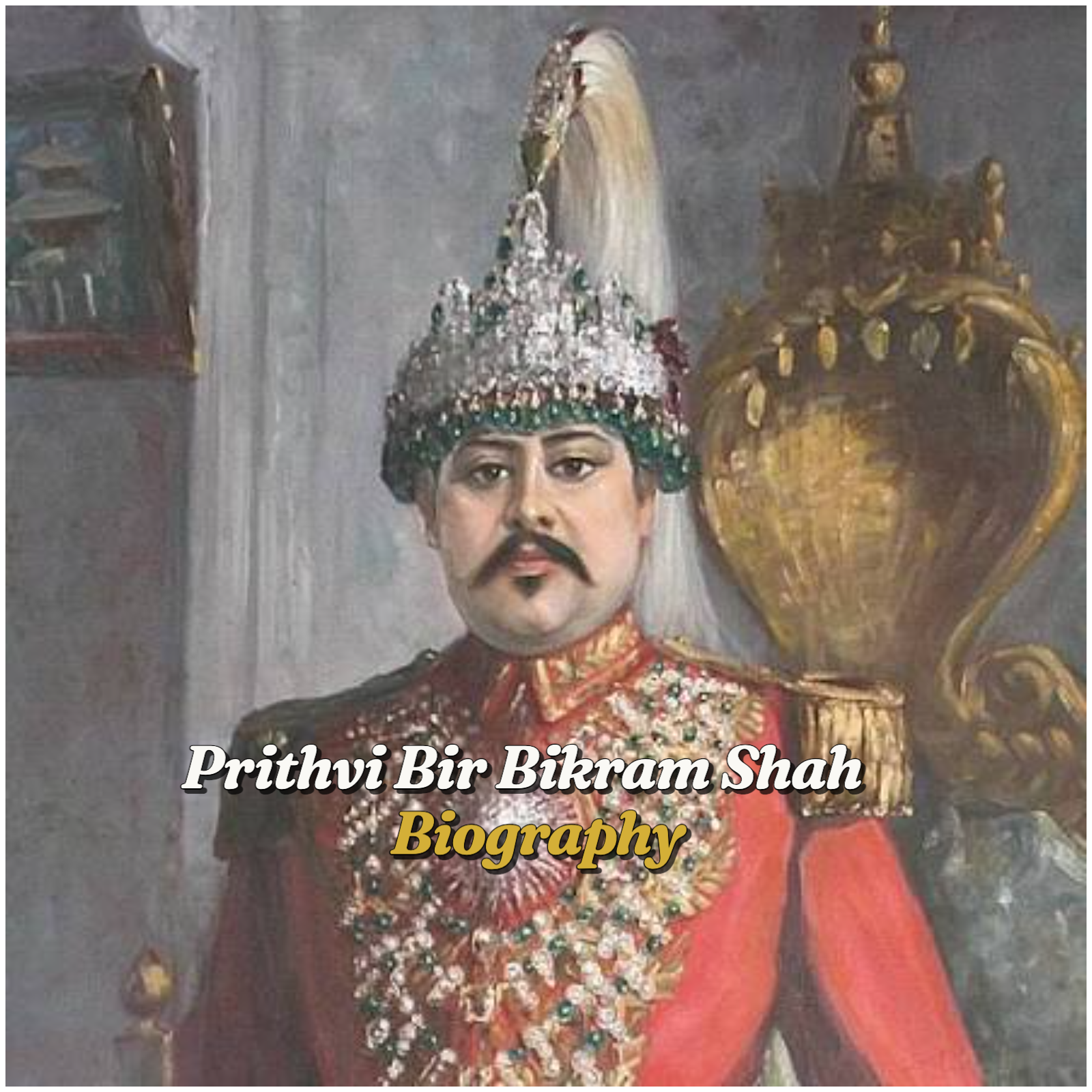
Prithvi Bir Bikram Shah was the seventh King of Nepal and ruled the country from May 17, 1881, until his death on December 11, 1911. Born into the Shah dynasty on August 18, 1875, he became king when he was only five years old following the death of his grandfather, King Surendra Bikram Shah. His father, Crown Prince Trailokya Bir Bikram Shah, had died three years earlier, in 1878, leaving the young Prithvi as the heir to the throne. He was formally crowned in December 1881.
Prithvi’s reign took place during one of the most restrictive periods in Nepalese political history. Although he was formally the sovereign, real political authority rested with the Rana prime ministers, whose family had controlled the government since the rise of Jung Bahadur Rana in the 19th century. By the time Prithvi became king, the Shah monarchy had already lost much of its practical authority, and the Rana prime minister controlled the administration, military and major affairs of state. Historical accounts describe Prithvi as a largely ceremonial monarch whose movements and access to other members of the royal family were closely controlled.
Despite the limited political authority attached to his position, Prithvi’s reign coincided with several changes in Nepal’s infrastructure and royal life. Automobiles were introduced into Nepal during his reign, and water and sanitation systems were developed in parts of the country. His thirty-year reign also witnessed the continued consolidation of Rana rule, the construction and expansion of royal and Rana palaces, and the increasingly controlled relationship between the Shah monarch and the Rana prime ministerial family. He died at the age of 36 in 1911 and was succeeded by his five-year-old son, Tribhuvan Bir Bikram Shah.
Prithvi Bir Bikram Shah Profile Summary
| Profile | Details |
|---|---|
| Full Name | Prithvi Bir Bikram Shah Dev |
| Regnal Name | Shree Paanch Maharajadhiraj Prithvi Bir Bikram Shah Dev |
| Born | August 18, 1875 |
| Birthplace | Basantapur, Kathmandu, Nepal |
| Died | December 11, 1911 |
| Age at Death | 36 |
| Nationality | Nepalese |
| Religion | Hinduism |
| Dynasty | Shah dynasty |
| Father | Crown Prince Trailokya Bir Bikram Shah |
| Mother | Lalit Rajeshwori Rajya Lakshmi Devi |
| Predecessor | Surendra Bikram Shah |
| Successor | Tribhuvan Bir Bikram Shah |
| Reign | May 17, 1881 – December 11, 1911 |
| Coronation | December 1, 1881 |
| Royal House | House of Shah |
| Wives | Raman Rajya Lakshmi Devi Shah, Divyeshwari Lakshmi Devi Shah, Kirti Rajya Lakshmi Devi Shah, Durga Rajya Lakshmi Devi Shah |
| Children | Princess Lakshmi, Princess Rama, Princess Tara, King Tribhuvan, Princess Suman, among others |
| Notable Reign Developments | Introduction of automobiles, water and sanitation development |
| Political Reality | Ceremonial monarch under Rana dominance |
| Successor’s Age | Five years old |
| None | |
| Net Worth | Not publicly quantifiable |
Prithvi Bir Bikram Shah Early Life
Prithvi Bir Bikram Shah was born on August 18, 1875, in Basantapur, Kathmandu, into the Shah royal family. He was the son of Crown Prince Trailokya Bir Bikram Shah and Lalit Rajeshwori Rajya Lakshmi Devi. His father was the eldest son of King Surendra Bikram Shah and therefore the direct heir to the Nepalese throne. Prithvi was consequently positioned to inherit the monarchy from birth, although the political circumstances surrounding his succession were shaped by the extraordinary power exercised by the Rana family.
His childhood was marked by an unusual separation between formal royal status and actual political authority. His father died in 1878, when Prithvi was still a young child, three years before his grandfather also died. When King Surendra died on May 17, 1881, Prithvi inherited the throne at only five years of age. Some historical accounts place his age at approximately six during his accession depending on the way the dates are counted, but his documented birth date and accession date establish that he was still a very young child.
The political environment into which Prithvi became king had already been transformed by the Rana regime. Since the mid-19th century, the Rana prime ministers had accumulated enormous power at the expense of the Shah monarchy. The king retained religious and ceremonial importance, but the prime minister exercised effective control over government. Prithvi therefore grew up in a royal household in which the monarch possessed enormous symbolic prestige while practical political authority was concentrated elsewhere.
Prithvi Bir Bikram Shah Education
There is relatively little reliable published information about Prithvi Bir Bikram Shah’s formal education. Unlike modern political figures and later Nepalese monarchs, detailed educational records for his childhood and royal tutoring have not been widely preserved in accessible sources. As a member of the Shah royal family, his upbringing would have taken place within the royal household and would have been shaped by the expectations of monarchy, religion, court culture and state ceremonial.
His childhood education also occurred within a highly controlled royal environment. The Rana leadership had a strong interest in preventing the Shah family from developing an independent political base. Historical research on Narayanhiti Palace shows that the royal residence was deliberately positioned and developed in ways that separated the king from older centres of Shah authority.
Because specific tutors, subjects and educational institutions associated with Prithvi have not been sufficiently established by reliable historical sources, it is safer not to attribute a detailed curriculum to him. What is clear is that his education took place against the background of a hereditary monarchy whose religious and ceremonial traditions remained important even as effective political authority had moved to the Rana prime ministers.
Prithvi Bir Bikram Shah Career
Prithvi Bir Bikram Shah’s Accession to the Throne
Prithvi became King of Nepal on May 17, 1881, following the death of his grandfather, King Surendra Bikram Shah. His accession occurred only a few years after the death of his father, Crown Prince Trailokya. Because Prithvi was still a child, his accession did not represent the emergence of a politically independent monarch. Instead, the Rana establishment continued to exercise effective authority over the kingdom.
He was formally crowned on December 1, 1881. His royal title was Shree Paanch Maharajadhiraj Prithvi Bir Bikram Shah Dev. The title reflected the religious and political symbolism attached to the Nepalese monarchy, even though the practical powers associated with the throne were severely restricted during the Rana era.
The contrast between the grandeur of the royal title and the limited authority of the monarch became one of the defining features of his reign. Prithvi was the sovereign in the formal constitutional and religious sense, but the Rana prime minister remained the effective head of government.
Prithvi Bir Bikram Shah and the Rana Regime
Prithvi’s entire reign occurred under Rana dominance. The Rana family had established a hereditary system in which the office of prime minister remained within the family and the prime minister exercised effective control over Nepal’s government, military and administration.
During Prithvi’s reign, the principal Rana prime ministers were Bir Shumsher Jung Bahadur Rana, Dev Shumsher Jung Bahadur Rana and Chandra Shumsher Jung Bahadur Rana. Bir Shumsher ruled from 1885 to 1901, Dev Shumsher briefly held office in 1901, and Chandra Shumsher then became prime minister and remained in power for decades.
This political arrangement meant that Prithvi did not function as an independent executive monarch. The Rana government controlled the major machinery of state, while the king’s position was largely ceremonial. The situation became particularly restrictive for the Shah royal family because the Rana leadership feared attempts to restore the monarchy’s former political authority.
Prithvi Bir Bikram Shah and Narayanhiti Palace
Prithvi’s relationship with Narayanhiti Palace is an important part of his history. Historical research records that he was moved to Narayanhiti Palace during the 1880s by the Rana prime minister Ranoddip Singh Kunwar Rana. The move deliberately separated the monarch from older Shah royal spaces from which the dynasty had historically exercised authority. The palace was subsequently expanded under Bir Shumsher and became a permanent royal residence.
Narayanhiti therefore became more than simply a royal residence. It was part of a wider political geography through which the Rana family managed the Shah monarchy. The palace’s location and development helped establish a new relationship between the ceremonial king and the government that actually exercised power.
Prithvi’s brothers were also subject to restrictions. Historical accounts state that several of them were moved or exiled to palaces in different parts of Nepal, including Palpa, Birgunj and Dhankuta, partly to prevent them from building independent political influence. Access to Prithvi himself could also be restricted.
Prithvi Bir Bikram Shah and the Introduction of Automobiles
One of the technological developments associated with Prithvi’s reign was the introduction of automobiles into Nepal. Historical accounts identify the arrival of the first automobiles during his reign as one of the notable developments of the period. The arrival of motor vehicles represented a significant technological change in a country whose transportation infrastructure was still largely based on traditional forms of travel.
The introduction of automobiles was closely connected with the Rana court and elite society rather than representing the beginning of mass automobile ownership in Nepal. Nevertheless, it marked the arrival of a technology that would eventually become an important part of the country’s modern transportation system.
For Prithvi himself, the development was another example of how technological changes could occur during a period in which the king’s formal position remained politically restricted.
Prithvi Bir Bikram Shah and Water and Sanitation
Water supply and sanitation also developed during Prithvi’s reign. Historical accounts identify the establishment of water and sanitation systems as among the notable developments associated with the period. These initiatives were particularly significant in Kathmandu, where the expanding royal and Rana administrative environment created new demands for organized water and sanitation infrastructure.
These developments should, however, be understood within the broader context of the Rana state. The improvements were not simply personal initiatives of Prithvi because effective government authority rested with the Rana prime ministers. They were developments of the state during a period when Prithvi occupied the throne.
Prithvi Bir Bikram Shah and Nepal’s International Position
Prithvi’s reign also occurred during a period in which Nepal maintained its distinct position between British India and the Himalayan region. Nepal had preserved its political independence despite the expansion of British power across the Indian subcontinent.
The Rana government maintained close relations with British India while preserving Nepal’s formal sovereignty. The king’s role in this system was largely ceremonial, with the Rana leadership directing practical foreign and military affairs.
The geopolitical environment was therefore another example of the distinction between Prithvi’s status as sovereign and the Rana prime minister’s control over the machinery of government.
Prithvi Bir Bikram Shah’s Honours
Prithvi was associated with the Order of Gorkha Dakshina Bahu, one of Nepal’s historic state honours. Sources identify him as sovereign of the order from 1896. The honour reflected the ceremonial and institutional position of the Nepalese monarch during his reign.
His honours and titles were part of the larger royal system through which the Shah monarchy retained religious and ceremonial prestige despite the political dominance of the Rana family.
Prithvi Bir Bikram Shah Trending: Why Is Prithvi Bir Bikram Shah Famous?
Prithvi Bir Bikram Shah is primarily remembered as the seventh King of Nepal and as the monarch who occupied the throne during the height of Rana political dominance. His unusual position has made him an important figure in Nepalese history because he was formally the sovereign while real executive power belonged to the Rana prime ministers.
He is also remembered because several notable changes in Nepal occurred during his reign, including the introduction of automobiles and the development of water and sanitation infrastructure. These developments took place within the Rana-controlled state rather than through an independently exercised royal government.
His family connection with King Tribhuvan has further increased his historical importance. Prithvi’s son inherited the throne at only five years old and later became the monarch associated with the eventual end of Rana rule and the restoration of greater political authority to the Shah monarchy.
Prithvi Bir Bikram Shah Death and Cause of Death
Prithvi Bir Bikram Shah died on December 11, 1911, in Kathmandu at the age of 36. His death brought a thirty-year reign to an end and resulted in another child monarch ascending the Nepalese throne. His five-year-old son, Tribhuvan Bir Bikram Shah, succeeded him.
The circumstances surrounding Prithvi’s death have been described as suspicious in historical accounts. Some sources state that he was poisoned, while other historical treatments describe his death more cautiously as occurring under suspicious circumstances. Because the available evidence does not establish a universally accepted account of an assassination, claims that he was deliberately poisoned should be presented as a historical allegation rather than an established fact.
His death was particularly significant because his successor was a very young child. Tribhuvan ascended the throne at the age of five, with his mother, Queen Divyeshwari, acting as regent. The Rana system consequently continued to exercise effective political authority during the early part of Tribhuvan’s reign.
Prithvi Bir Bikram Shah Personal Life
Prithvi Bir Bikram Shah belonged to the Shah dynasty and was the son of Crown Prince Trailokya Bir Bikram Shah and Lalit Rajeshwori Rajya Lakshmi Devi. His family occupied the highest ceremonial position in Nepal, but the royal household lived under considerable political restrictions imposed by the Rana establishment. His brothers and other members of the extended royal family were dispersed to different palaces, partly because the Rana rulers feared attempts to restore independent Shah authority.
Prithvi had several wives, including Raman Rajya Lakshmi Devi Shah, Divyeshwari Lakshmi Devi Shah, Kirti Rajya Lakshmi Devi Shah and Durga Rajya Lakshmi Devi Shah. Queen Divyeshwari, whom he married in 1886, became particularly important in Nepalese royal history because she was the mother of his son Tribhuvan. She was originally from Kangra and became Queen Consort of Nepal until Prithvi’s death in 1911.
Prithvi had several children, including Princess Lakshmi, Princess Rama, Princess Tara, Tribhuvan and Princess Suman. Princess Lakshmi was his eldest child and at one point was regarded as the heir to the throne before the birth of her younger brother Tribhuvan. Tribhuvan was born to Queen Divyeshwari in 1906 and eventually became Prithvi’s successor.
Prithvi Bir Bikram Shah Age, Religion, Nationality, Height and Physical Appearance
Prithvi Bir Bikram Shah was born on August 18, 1875, and died on December 11, 1911, making him 36 years old at the time of his death; he was a Nepalese king of the Shah dynasty and is identified with Hinduism, the religion historically associated with the Nepalese monarchy. He was born in Basantapur, Kathmandu, and spent his life within the Nepalese royal court. His exact height, weight and other physical measurements were not recorded in reliable accessible historical sources, so modern claims about his height should be treated cautiously. Surviving historical portraits generally depict him wearing elaborate Nepalese royal attire, including ceremonial headgear and formal military-style regalia, reflecting the visual traditions of the Shah monarchy and the court culture of the period.
Prithvi Bir Bikram Shah Legacy
Prithvi Bir Bikram Shah’s historical legacy is closely tied to the unusual political position he occupied. He was the formal sovereign of Nepal for three decades, but his reign took place during the period when the Rana family exercised effective control over government. His life therefore illustrates the sharp difference between ceremonial kingship and actual political authority in Rana-era Nepal.
His reign is also remembered for developments that reflected Nepal’s gradual encounter with modern technology and infrastructure. Automobiles appeared in Nepal during his reign, while water and sanitation systems were developed in parts of the country. These developments occurred under the Rana-controlled government, but they form part of the historical context of the thirty years in which Prithvi occupied the throne.
Perhaps the most consequential part of Prithvi’s legacy was his son Tribhuvan. When Prithvi died in 1911, Tribhuvan inherited the throne at only five years old. Decades later, Tribhuvan would become a central figure in the political transformation that ended Rana rule and restored greater authority to the Shah monarchy. Prithvi’s short life and long ceremonial reign therefore form an important link between the older Rana-controlled monarchy and the political changes that eventually transformed Nepal.
Conclusion
Prithvi Bir Bikram Shah was the seventh King of Nepal and ruled from 1881 until his death in 1911, spending his entire reign within the political system created by the Rana family. He inherited the throne as a young child after the death of his grandfather, while his father had already died several years earlier. Although he carried the title and ceremonial authority of Nepal’s monarch, the Rana prime ministers controlled the government and imposed substantial restrictions on the royal family. His reign nevertheless coincided with the introduction of automobiles and the development of water and sanitation infrastructure, while his personal life included several marriages and a number of children, most importantly his son Tribhuvan. Prithvi died at 36 under circumstances that later accounts have described as suspicious, with poisoning appearing in some sources but not established beyond dispute. His death placed another child on the throne and ultimately connected his reign to the later political transformation led by his son Tribhuvan.
Frequently Asked Questions About Prithvi Bir Bikram Shah
Who was Prithvi Bir Bikram Shah?
Prithvi Bir Bikram Shah was the seventh King of Nepal and ruled from May 17, 1881, until December 11, 1911.
When was Prithvi Bir Bikram Shah born?
Prithvi Bir Bikram Shah was born on August 18, 1875, in Basantapur, Kathmandu, Nepal.
How old was Prithvi Bir Bikram Shah when he became king?
Prithvi was a young child when he became king in 1881. He was approximately five to six years old, depending on how the dates are counted.
How old was Prithvi Bir Bikram Shah when he died?
Prithvi Bir Bikram Shah was 36 years old when he died on December 11, 1911.
Who succeeded Prithvi Bir Bikram Shah?
His son Tribhuvan Bir Bikram Shah succeeded him. Tribhuvan was only five years old when he became king.
Who was Prithvi Bir Bikram Shah’s wife?
Prithvi had several wives, including Raman Rajya Lakshmi Devi Shah, Divyeshwari Lakshmi Devi Shah, Kirti Rajya Lakshmi Devi Shah and Durga Rajya Lakshmi Devi Shah.
Who was Queen Divyeshwari?
Queen Divyeshwari Lakshmi Devi Shah was Prithvi Bir Bikram Shah’s second wife and the mother of his son and successor, King Tribhuvan. She served as Queen Consort from 1886 until Prithvi’s death in 1911.
How many children did Prithvi Bir Bikram Shah have?
Historical sources identify several children, including Princess Lakshmi, Princess Rama, Princess Tara, King Tribhuvan and Princess Suman. Some accounts indicate additional children associated with his different wives.
What religion was Prithvi Bir Bikram Shah?
Prithvi Bir Bikram Shah was a Hindu and belonged to the Hindu Shah royal tradition of Nepal.
What happened to Prithvi Bir Bikram Shah?
He died in Kathmandu on December 11, 1911, at the age of 36. Some historical sources describe his death as poisoning or suspicious circumstances, but the exact circumstances are not conclusively established across the available accounts.
Was Prithvi Bir Bikram Shah a powerful king?
Prithvi held the formal position of king, but his actual political authority was severely limited by the Rana regime. The Rana prime ministers exercised effective control over Nepal’s government during his reign.
What happened during Prithvi Bir Bikram Shah’s reign?
His reign saw the continuation of Rana political dominance as well as developments such as the introduction of automobiles and the development of water and sanitation systems in parts of Nepal.
Who was Prithvi Bir Bikram Shah’s father?
His father was Crown Prince Trailokya Bir Bikram Shah, the eldest son of King Surendra Bikram Shah. Trailokya died in 1878, three years before Prithvi became king.
Who was Prithvi Bir Bikram Shah’s mother?
His mother was Lalit Rajeshwori Rajya Lakshmi Devi.
What dynasty did Prithvi Bir Bikram Shah belong to?
Prithvi belonged to the Shah dynasty, the royal dynasty that ruled Nepal until the monarchy was abolished in 2008.