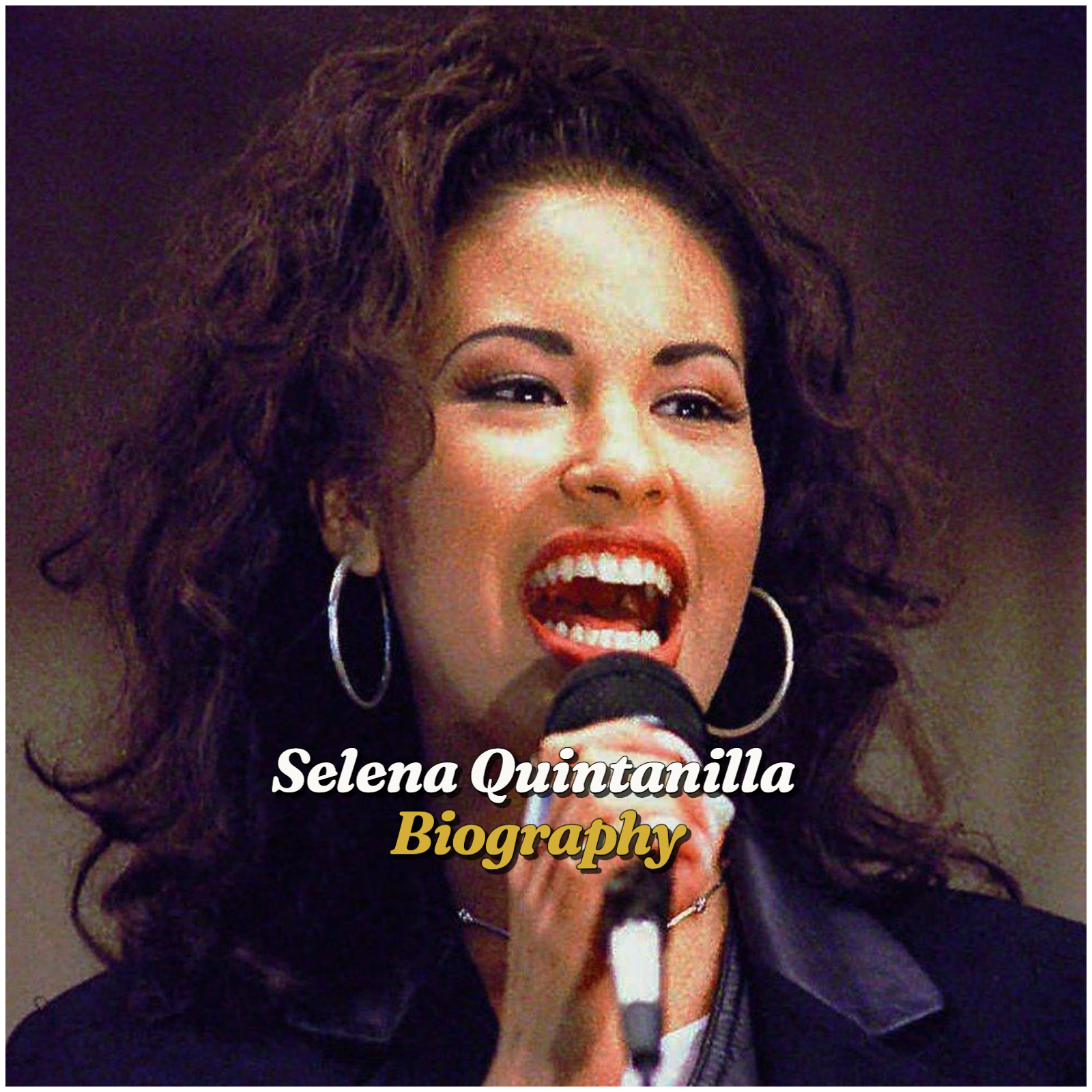
Selena Quintanilla-Pérez, popularly known simply as Selena, was an American singer, songwriter, fashion designer and entrepreneur who became known worldwide as the Queen of Tejano Music. Born on April 16, 1971, in Lake Jackson, Texas, she rose from performing with her family’s band, Selena y Los Dinos, to becoming one of the most influential Mexican-American entertainers of her generation. Her career combined Tejano music, Mexican-American cultural identity, fashion and an increasingly ambitious attempt to cross into the mainstream American pop market.
Selena’s breakthrough came during the late 1980s and early 1990s, when her powerful voice, energetic performances and distinctive fashion helped expand the audience for Tejano music. Her 1993 album Live! won the Grammy Award for Best Mexican-American Album at the 36th Grammy Awards in 1994, making her the first female Tejano artist to win that category. Her success continued with Amor Prohibido, while plans for a major English-language crossover were underway when her life was suddenly cut short at the age of 23.
Selena was murdered on March 31, 1995, by Yolanda Saldívar, the former president of her fan club and manager of her clothing boutiques. Her death transformed her from a rapidly rising star into a lasting cultural icon. Her posthumous album Dreaming of You reached No. 1 on the Billboard 200, while her story has subsequently been preserved through music, film, fashion, museums, awards, documentaries and generations of artists influenced by her work.
Selena Quintanilla Profile Summary
| Fact | Details |
|---|---|
| Full name | Selena Quintanilla-Pérez |
| Popular name | Selena |
| Nickname | Queen of Tejano Music |
| Born | April 16, 1971 |
| Birthplace | Lake Jackson, Texas, United States |
| Age at death | 23 years |
| Date of death | March 31, 1995 |
| Place of death | Corpus Christi, Texas, United States |
| Nationality | American |
| Ethnic background | Mexican-American |
| Religion | Raised as a Jehovah’s Witness |
| Profession | Singer, songwriter, fashion designer and entrepreneur |
| Musical genre | Tejano, Latin pop, cumbia, Mexican regional music |
| Father | Abraham Quintanilla Jr. |
| Mother | Marcella Ofelia Quintanilla |
| Siblings | A.B. Quintanilla III and Suzette Quintanilla |
| Husband | Chris Pérez |
| Marriage | 1992–1995 |
| Children | None |
| Famous band | Selena y Los Dinos |
| Grammy | Best Mexican-American Album, 1994 |
| Major albums | Selena, Ven Conmigo, Entre a Mi Mundo, Selena Live!, Amor Prohibido, Dreaming of You |
| Famous songs | “Como La Flor,” “Amor Prohibido,” “Bidi Bidi Bom Bom,” “No Me Queda Más,” “Dreaming of You” |
| Height | Approximately 1.65 m (5 ft 5 in) |
| @selenaqofficial | |
| Cause of death | Gunshot wound |
| Killer | Yolanda Saldívar |
| Estimated net worth at death | Approximately $5 million, according to widely circulated estimates |
Selena Quintanilla Early Life
Selena Quintanilla was born on April 16, 1971, in Lake Jackson, Texas, to Abraham Quintanilla Jr. and Marcella Ofelia Quintanilla. She was the youngest of the couple’s three children, with an older brother, Abraham Isaac Quintanilla III, known professionally as A.B. Quintanilla, and an older sister, Suzette Quintanilla. Her father had previously been a musician, and his experience would eventually play an important role in turning the family’s musical abilities into a professional career.
Selena grew up in a Mexican-American family in Texas and was raised primarily in the Corpus Christi area. Although English was her first language, her father recognised her natural singing ability and taught her to perform in Spanish so that she could connect with the Latino community. She initially learned Spanish lyrics phonetically and later became comfortable singing and speaking the language. Her bicultural identity would eventually become one of the defining characteristics of her public image.
Her professional musical journey began remarkably early. When Selena was about 10 years old, she became the lead singer of the family group that became known as Selena y Los Dinos, with A.B. playing bass and Suzette playing drums. The group initially performed at weddings, restaurants, clubs and other local venues. The family eventually moved toward a more serious musical career, and Abraham Quintanilla became the group’s manager and driving force.
Selena Quintanilla Education
Selena’s education was affected by the demands of her rapidly developing music career. As Selena y Los Dinos became increasingly busy performing throughout Texas and the surrounding region, maintaining a conventional school schedule became difficult. Her father ultimately arranged for her education to accommodate her professional responsibilities.
As her music career expanded, Selena attended school while continuing to perform with her family. She eventually completed her high-school education through correspondence study. Despite beginning professional performances at an unusually young age, she continued to value education and later obtained a high-school diploma from the American School of Correspondence in Chicago.
Selena’s formal academic path did not continue into a traditional university career because music had already become her full-time profession. Her education instead took place alongside the demanding practical experience of touring, recording, performing, songwriting, fashion design and managing aspects of the family’s growing entertainment business. Her career therefore became a form of professional education in itself, exposing her to music production, business, branding and entrepreneurship while she was still very young.
Selena Quintanilla Career
Selena’s professional career began with Selena y Los Dinos, the family band that provided the foundation for almost everything she accomplished. Under Abraham Quintanilla’s management, the group gradually developed from a local act into one of the most successful Tejano bands of its era. Their music combined traditional Mexican and Tejano influences with elements of pop, cumbia, rock and other contemporary sounds.
Selena Quintanilla and Selena y Los Dinos
Selena y Los Dinos began performing professionally while Selena was still a child. The family group initially played small venues, weddings, restaurants and clubs before gradually establishing a larger following. Selena’s brother A.B. became an important songwriter and producer within the group, while Suzette played drums and Abraham managed the operation.
The group’s early recordings helped Selena develop the musical style that would eventually make her famous. Although she initially faced resistance in a male-dominated Tejano industry, her voice, stage presence and growing popularity helped establish her as one of the genre’s most important female performers.
Selena’s early albums included Selena in 1989, Ven Conmigo in 1990 and Entre a Mi Mundo in 1992. Her recordings increasingly reached audiences beyond the regional Tejano market, while songs such as “Como La Flor” became major parts of her musical identity.
Selena Quintanilla’s Breakthrough
A major turning point came in 1989 when Selena performed at the Tejano Music Awards in San Antonio. Music executive José Behar, who was establishing EMI Latin, saw her performance and recognised her potential for a much larger career. Selena subsequently signed with EMI Latin, with the label viewing her as an artist capable of crossing beyond the Tejano market.
Her popularity grew rapidly during the early 1990s. She developed a reputation for energetic live performances, powerful vocals and a charismatic relationship with audiences. Her music also demonstrated that a young Mexican-American artist could embrace her cultural heritage while incorporating contemporary American pop influences.
Her growing popularity was reflected in increasingly successful albums. Entre a Mi Mundo helped establish her as a major Tejano star, while Amor Prohibido, released in 1994, expanded her audience further. The album produced several No. 1 songs on Billboard’s Hot Latin Songs chart, including “Amor Prohibido,” “Bidi Bidi Bom Bom,” “No Me Queda Más” and “Fotos y Recuerdos.”
Selena Quintanilla’s Grammy Win
In 1994, Selena reached one of the most important milestones of her career when Live! won Best Mexican-American Album at the 36th Grammy Awards. The award was particularly significant because she became the first female Tejano artist to win that Grammy category.
Selena’s Grammy victory came when she was only 22 years old. She accepted the award wearing the white crystal-studded gown that became one of her most recognisable fashion moments. The victory helped establish her as a major figure beyond the regional Tejano scene and demonstrated the wider commercial potential of her music.
The Grammy recognition also contributed to Selena’s growing reputation as an artist capable of connecting different cultural audiences. She sang primarily in Spanish while having grown up in the United States, and her career increasingly represented the possibility of moving between Mexican-American and mainstream American cultural spaces.
Selena Quintanilla and Amor Prohibido
Amor Prohibido, released in 1994, became one of Selena’s defining albums. The record combined Tejano traditions with contemporary production and songs that dealt with love, relationships and social circumstances. Its commercial success established Selena as one of the biggest Latin recording artists in the United States.
The album reached No. 29 on the Billboard 200 and eventually achieved double-platinum status. Four of its songs reached No. 1 on Billboard’s Hot Latin Songs chart, giving Selena an extraordinary run of success shortly before her death.
The success of Amor Prohibido was especially important because Selena was already preparing for a broader English-language career. Her team and label believed she could become a major crossover star in the mainstream American market, and recording sessions for what would eventually become Dreaming of You were already underway.
Selena Quintanilla as a Fashion Designer and Entrepreneur
Selena’s influence extended well beyond music. She had a strong interest in fashion and frequently designed or helped design the clothing she wore on stage. Her performance outfits, including bustiers, sequined costumes, distinctive hairstyles and bold accessories, became closely associated with her identity.
She and her family also established the Selena Etc. boutiques, which sold clothing and other fashion products. The boutiques reflected her ambition to build a business empire alongside her music career. She was involved in the design and presentation of her fashion brand, making her one of the early Latin entertainers to develop a recognisable personal brand that extended beyond recorded music.
Her fashion influence continued long after her death. The purple jumpsuit she wore during her famous 1995 Houston Astrodome performance became one of her most recognisable outfits. The garment was later referenced in the 1997 biographical film and has remained part of exhibitions celebrating her life and work.
Selena Quintanilla’s Final Concert
On February 26, 1995, Selena performed at the Houston Astrodome as part of the Houston Livestock Show and Rodeo. The concert attracted more than 66,000 people and became her final major televised performance.
The performance demonstrated the scale Selena had reached just before her death. She was no longer simply a successful regional Tejano singer. She was becoming a major Latin American and American entertainment figure with an audience capable of filling one of Texas’s largest venues.
Only weeks later, her career was abruptly ended. At the time of her death, Selena was working toward an English-language crossover project that her label expected could introduce her to an even larger mainstream audience.
Selena Quintanilla’s Posthumous Dreaming of You
Following Selena’s death, EMI Latin released Dreaming of You on July 18, 1995. The album combined previously recorded English-language material with Spanish-language songs and earlier recordings.
The album debuted at No. 1 on the Billboard 200, becoming the first predominantly Spanish-language album to reach the top of that chart. It sold approximately 175,000 copies in the United States on its first day, an extraordinary figure at the time.
The success of Dreaming of You demonstrated the scale of the mainstream audience Selena had been developing before her death. Songs such as “I Could Fall in Love” and “Dreaming of You” became major posthumous hits, while the album transformed her unfinished crossover ambition into a documented part of music history.
Selena Quintanilla Trending: Why Is Selena Quintanilla Famous?
Selena remains a heavily searched cultural figure because her influence continues to cross music, fashion, film and Latino identity. Her 30th death anniversary in 2025 generated renewed attention, while the Netflix documentary Selena y Los Dinos: A Family’s Legacy brought previously unseen family footage and intimate interviews to a new international audience. The documentary premiered at the 2025 Sundance Film Festival, where it received the U.S. Documentary Special Jury Award for Archival Storytelling, before arriving on Netflix in November 2025.
Selena also remains prominent in music institutions. In 2026, the Recording Academy announced that Selena recordings would be inducted into the Grammy Hall of Fame, with the ceremony scheduled for May 8, 2026. This followed her earlier Grammy Lifetime Achievement Award, which was announced in 2020 and recognised in the Academy’s 2021 awards cycle.
Another major source of continuing interest is her fashion and cultural legacy. The Grammy Museum’s Selena: From Texas to the World exhibition displayed personal artifacts, her Grammy, instruments associated with Selena y Los Dinos and some of her iconic clothing. The exhibition was extended through May 11, 2026, reflecting continued public interest in her life and artistry.
Selena Quintanilla Personal Life
Selena was born into a close-knit musical family. Her father, Abraham Quintanilla Jr., managed Selena y Los Dinos and played a central role in shaping her career. Her brother A.B. became one of her principal musical collaborators and songwriters, while her sister Suzette played drums in the family band. The family relationship remained central to Selena’s career from childhood until her death.
Selena married guitarist and songwriter Chris Pérez in 1992. Their relationship had initially faced opposition from her father, who was concerned about Pérez’s place in the family group and Selena’s career. The couple ultimately eloped on April 2, 1992, when Selena was 20 years old. Pérez subsequently remained her husband and musical collaborator until her death in 1995.
Selena and Chris Pérez had no children during their marriage. Her relationship with Pérez has remained an important part of her biography, particularly because their personal story has been revisited in books, documentaries and other accounts of her life. In the 2025 documentary about Selena y Los Dinos, Pérez participated alongside the Quintanilla family, with her sister Suzette describing him as still being a close member of the family decades after Selena’s death.
Selena Quintanilla Age, Religion, Nationality, Height and Physical Appearance
Selena Quintanilla was 23 years old when she died on March 31, 1995. She had been born on April 16, 1971, in Lake Jackson, Texas, meaning that she was only a few weeks short of her 24th birthday. Her life and career therefore unfolded within an exceptionally short period, with her professional recording career lasting only about six years before her death.
Selena was raised as a Jehovah’s Witness in her family, although her public career was primarily associated with her Mexican-American cultural identity and her music rather than religious advocacy. Her religious upbringing formed part of her childhood environment, while her later public identity became strongly connected with her family, culture, music and fashion.
She was American, having been born in Texas, and came from a Mexican-American family of Mexican heritage. Selena’s bicultural identity became one of the defining aspects of her appeal. She grew up speaking English but learned to sing in Spanish, eventually becoming a major Spanish-language recording artist despite having been raised in the United States. Her career consequently resonated with audiences navigating both American and Mexican cultural identities.
Selena’s height is commonly reported as approximately 1.65 metres, or 5 feet 5 inches. She had dark brown hair and brown eyes and became especially recognisable for her glamorous stage appearance, bold makeup, large earrings and distinctive performance clothing. Her fashion was not merely part of her appearance but became an important component of her artistic identity, with many of her stage costumes being designed or developed with her own involvement. The purple jumpsuit from her final Houston Astrodome concert remains one of the most recognisable examples of her fashion legacy.
Selena Quintanilla Cause of Death and Death
Selena Quintanilla was shot and killed on March 31, 1995, in Corpus Christi, Texas. She was 23 years old. The shooting was carried out by Yolanda Saldívar, who had been the president of Selena’s fan club and the manager of Selena’s clothing boutiques.
The circumstances surrounding the murder developed from financial disputes involving Saldívar. Selena and her family had become concerned about missing money and financial records connected to the fan club and boutiques. Selena met Saldívar at a Days Inn motel in Corpus Christi on March 31, 1995, to obtain documentation and address the dispute.
During the confrontation, Saldívar shot Selena. Selena managed to reach the motel lobby and identify Saldívar as the shooter before collapsing. She was transported to a hospital but could not be saved and was pronounced dead later that morning.
Saldívar was subsequently arrested and prosecuted for murder. She was convicted of first-degree murder in October 1995 and received a life sentence with the possibility of parole after 30 years. In 2025, the Texas Board of Pardons and Paroles denied her first request for parole, and she is scheduled for another review in 2030.
Selena’s death produced an enormous public reaction across Texas, the United States and Latin America. Her funeral attracted thousands of mourners, while fans continued to gather around locations associated with her life. The tragedy also transformed the trajectory of her career because her unfinished English-language crossover project and expanding cultural influence became part of her posthumous legacy.
Selena Quintanilla Net Worth
Selena Quintanilla’s exact personal net worth at the time of her death was never established through a publicly audited figure. The approximately $5 million figure supplied in the Gemini research is widely circulated in celebrity-biography accounts and can reasonably be described as an estimate of her wealth at the time of her death rather than a verified financial statement.
By 1995, Selena had become a highly successful recording artist and entrepreneur. She had generated income from album sales, concerts, merchandise, endorsements and her Selena Etc. boutiques, while her career was expanding into the mainstream American market. HISTORY notes that she had become a millionaire by age 19, illustrating how quickly her commercial success had developed.
The long-term financial value of Selena’s estate became much larger than what her personal fortune represented during her lifetime. Posthumous album sales, licensing, merchandise, films, documentaries, fashion collaborations and other uses of her name and likeness have generated continuing commercial activity. Her estate’s ongoing operations, however, should not be confused with a verified calculation of Selena’s personal net worth at the time of her death.
Selena Quintanilla Legacy
Selena’s most significant musical legacy is her role in expanding Tejano music beyond its established regional audience. At a time when Tejano was heavily male-dominated, she became its most recognisable female star and demonstrated that Spanish-language music rooted in Mexican-American culture could reach mainstream American audiences. Her 1994 Grammy victory remains a landmark in the history of Tejano music because she became the first female Tejano artist to win that category.
Her influence also extends into fashion and popular culture. Selena designed many of her own stage outfits and developed a visual identity that included bustiers, bold jewellery, distinctive makeup and colourful performance clothing. Her influence later appeared in the 1997 film Selena, MAC Cosmetics collections, clothing collaborations and museum exhibitions. She received a posthumous star on the Hollywood Walk of Fame in 2017, with more than 4,500 fans attending the ceremony.
Selena’s cultural legacy has continued to grow across generations. The Recording Academy awarded her a posthumous Lifetime Achievement Award, while her recordings have continued to receive institutional recognition. Her family has also continued to preserve her story through the Selena Museum, Q Productions and archival projects. The 2025 documentary Selena y Los Dinos: A Family’s Legacy and the 2026 Grammy Hall of Fame recognition demonstrate that three decades after her death, Selena remains an active part of the cultural history of American and Latin music.
Conclusion
Selena Quintanilla was a groundbreaking Mexican-American singer, songwriter, fashion designer and entrepreneur whose career transformed the visibility of Tejano music and established her as one of the most important Latin music figures of the 20th century. From performing with her family’s band as a child to winning a Grammy, building a fashion business and preparing for an English-language crossover, she achieved extraordinary success before her murder at just 23. Her music, fashion, cultural identity and connection with her fans have allowed her influence to survive across generations, while continuing recognition from the Grammy Awards, museums, filmmakers and contemporary artists has ensured that the Queen of Tejano remains a major figure in American popular culture.
Frequently Asked Questions About Selena Quintanilla
Who was Selena Quintanilla?
Selena Quintanilla was an American singer, songwriter, fashion designer and entrepreneur who became known as the Queen of Tejano Music.
When was Selena Quintanilla born?
Selena Quintanilla was born on April 16, 1971, in Lake Jackson, Texas.
How old was Selena Quintanilla when she died?
Selena Quintanilla was 23 years old when she died on March 31, 1995.
When did Selena Quintanilla die?
Selena Quintanilla died on March 31, 1995, in Corpus Christi, Texas.
What was Selena Quintanilla’s cause of death?
Selena Quintanilla died from a gunshot wound after being shot by Yolanda Saldívar, the former president of her fan club and manager of her boutiques.
Who killed Selena Quintanilla?
Yolanda Saldívar killed Selena Quintanilla in 1995. Saldívar was convicted of first-degree murder and sentenced to life imprisonment.
Who was Selena Quintanilla’s husband?
Selena Quintanilla’s husband was Chris Pérez, a guitarist and songwriter who played with Selena y Los Dinos. They married in 1992 and remained together until her death in 1995.
Did Selena Quintanilla have children?
No. Selena Quintanilla and Chris Pérez did not have children during their marriage.
What religion was Selena Quintanilla?
Selena was raised as a Jehovah’s Witness.
What nationality was Selena Quintanilla?
Selena Quintanilla was American and was of Mexican-American heritage.
How tall was Selena Quintanilla?
Selena Quintanilla was approximately 1.65 metres, or 5 feet 5 inches tall.
What was Selena Quintanilla famous for?
Selena was famous for helping bring Tejano music into the mainstream, her Grammy-winning music, distinctive fashion, entrepreneurial work and her influence on Mexican-American and Latin pop culture.
Why was Selena called the Queen of Tejano Music?
Selena became known as the Queen of Tejano Music because of her extraordinary popularity and influence within Tejano music. She also became the first female Tejano artist to win a Grammy in the Best Mexican-American Album category.
What Grammy did Selena Quintanilla win?
Selena won the Grammy Award for Best Mexican-American Album for Live! at the 36th Grammy Awards in 1994.
What happened to Selena’s album Dreaming of You?
Dreaming of You was released posthumously in July 1995. It debuted at No. 1 on the Billboard 200, becoming the first predominantly Spanish-language album to reach the top of that chart.
What was Selena Quintanilla’s net worth?
Selena Quintanilla’s exact net worth was never officially verified. A commonly cited estimate places her wealth at approximately $5 million at the time of her death, although this should be treated as an estimate rather than an audited figure.
What was Selena Quintanilla’s most famous song?
Some of Selena’s best-known songs include “Como La Flor,” “Amor Prohibido,” “Bidi Bidi Bom Bom,” “No Me Queda Más” and “Dreaming of You.”
Is Selena Quintanilla still famous today?
Yes. Selena remains influential decades after her death through her music, fashion, films, documentaries, museum exhibitions and continuing recognition from the Recording Academy. Her 2025 family documentary and 2026 Grammy Hall of Fame recognition have also renewed public interest in her career.
What is Selena Quintanilla’s Instagram account?
Selena’s estate maintains the Instagram account @selenaqofficial as part of the ongoing preservation and promotion of her legacy.