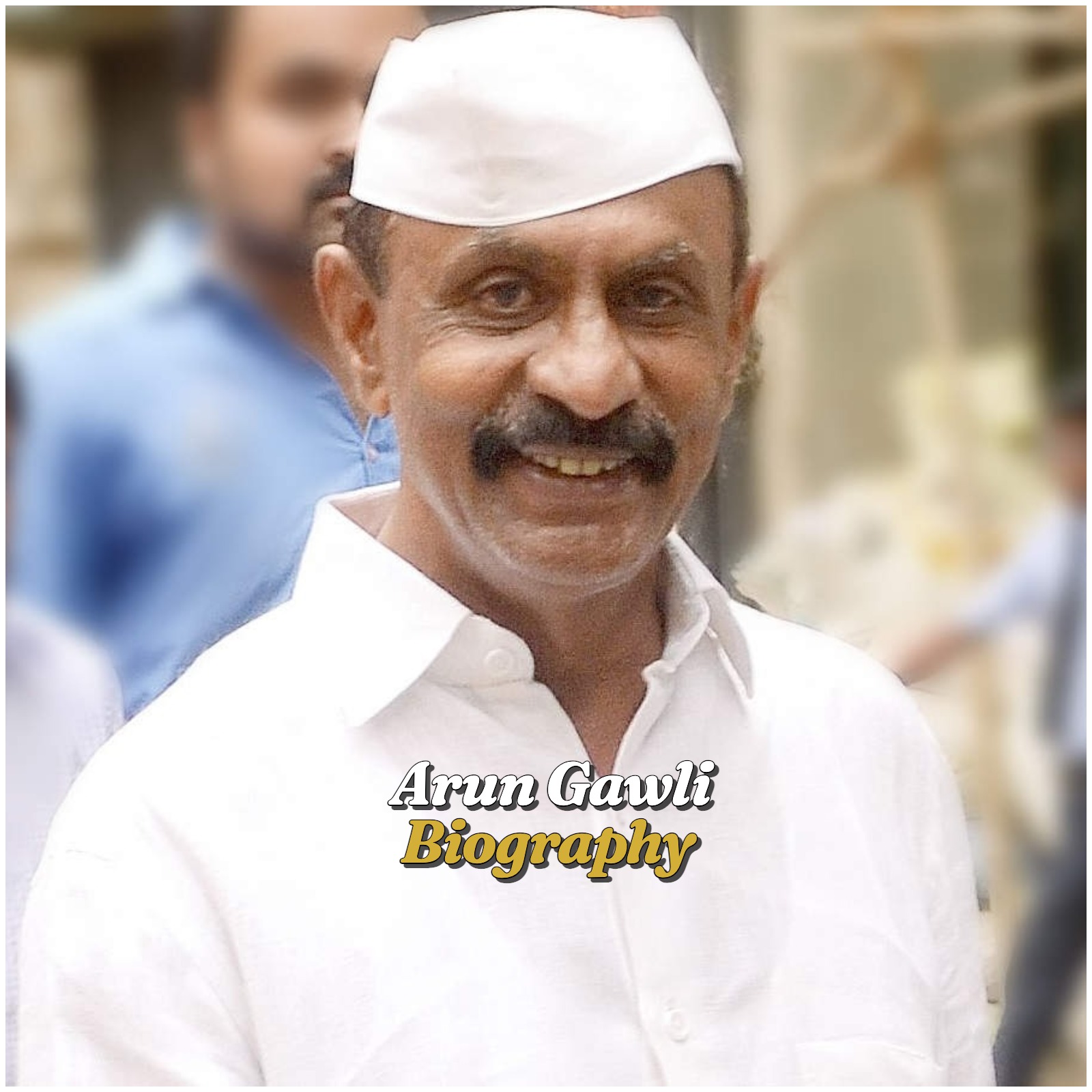
Arun Gulab Gawli, also known as Arun Gawli or “Daddy,” is a former Mumbai underworld figure and politician whose life became closely associated with Dagdi Chawl in Byculla. He rose through Mumbai’s organised-crime networks during the 1970s and 1980s and eventually became the leader of his own gang. His criminal career included conflicts with rival groups, particularly Dawood Ibrahim’s D-Company, while his later political career took him from the streets of central Mumbai to the Maharashtra Legislative Assembly.
Gawli founded the Akhil Bharatiya Sena (ABS) in 1997 and entered electoral politics, eventually winning the Chinchpokli Assembly constituency in the 2004 Maharashtra legislative election. He served as an MLA from 2004 to 2009. His political career was interrupted by criminal proceedings, and in 2012 he was convicted in the murder of Shiv Sena corporator Kamlakar Jamsandekar and sentenced to life imprisonment. The Bombay High Court upheld the conviction in 2019.
After spending nearly 18 years in prison, Gawli was released on conditional bail in September 2025 while his appeal remained pending. In September 2026, he attracted renewed national attention after making a rare public appearance at the Lalbaugcha Raja Ganesh festival in Mumbai. His appearance on September 24, immediately before Anant Chaturdashi, drew large crowds and became the latest chapter in the long public story of the former gangster-turned-politician.
Arun Gawli Profile Summary
| Profile | Details |
|---|---|
| Full Name | Arun Gulab Gawli |
| Other Name | Arun Gulab Ahir |
| Nickname | Daddy |
| Date of Birth | July 17, 1955 |
| Age | 71 years |
| Place of Birth | Ahmednagar district, Maharashtra, India |
| Nationality | Indian |
| Religion | Hinduism |
| Profession | Former gangster, politician |
| Political Party | Akhil Bharatiya Sena |
| Constituency | Chinchpokli, Maharashtra |
| MLA Term | 2004–2009 |
| Wife | Asha Gawli |
| Children | Five publicly reported children |
| Famous Residence/Base | Dagdi Chawl, Byculla, Mumbai |
| Major Criminal Conviction | Murder of Kamlakar Jamsandekar |
| Sentence | Life imprisonment |
| Film Based on His Life | Daddy (2017) |
| Social Media | No verified personal account |
| Current Legal Status | Released on conditional bail while appeal remains pending |
Arun Gawli Early Life
Arun Gulab Gawli was born on July 17, 1955, in the Ahmednagar district of Maharashtra, although his family later became associated with Mumbai. His father, Gulabrao Gawli, migrated to Mumbai in search of work during the 1950s and worked in the city’s mills. The family’s later association with central Mumbai would become an important part of Arun Gawli’s identity and eventual political base.
Before entering the criminal underworld, Gawli worked in several industrial jobs. Accounts of his early working life identify employment at Simplex Mills in Chinchpokli, Godrej & Boyce in Vikhroli and Crompton Greaves in Kanjurmarg. His movement through Mumbai’s industrial working-class neighbourhoods placed him close to the communities that later formed the social environment around Dagdi Chawl.
Gawli’s childhood and youth were therefore shaped by the working-class districts of Mumbai rather than by wealth or political privilege. His family background, local networks and long association with Byculla eventually became central to his public identity. In later years, supporters in Dagdi Chawl referred to him as “Daddy,” a nickname that remained attached to him even after his transition from organised crime to electoral politics.
Arun Gawli Education
There is limited reliable public documentation concerning Arun Gawli’s formal education. Unlike many contemporary politicians, his biographies generally focus on his working-class upbringing, industrial employment, criminal career and subsequent political activities rather than listing a detailed academic history.
His early professional life appears to have centred on employment rather than university education. Before becoming a major figure in Mumbai’s underworld, he worked in industrial establishments and later became involved with criminal networks. These experiences placed him within the working-class communities of central Mumbai that eventually became his political constituency.
His lack of a prominent formal academic profile did not prevent him from entering electoral politics. By the early 2000s, he had developed sufficient local recognition to contest elections through the Akhil Bharatiya Sena. In 2004, he won Chinchpokli and entered the Maharashtra Legislative Assembly, marking the formal transition of his public career from organised crime into elected politics.
Arun Gawli Career
Arun Gawli’s criminal career developed in Mumbai’s underworld during the 1970s. Along with his brother Kishor, known as “Pappa,” he became associated with the Byculla Company, a gang led by Rama Naik and Babu Reshim that operated across parts of central Mumbai. Gawli’s early involvement came during a period when organised crime, illegal liquor, extortion, gambling and other criminal activities were deeply embedded in parts of Mumbai’s underworld.
A major turning point came in 1988, when Rama Naik was killed in a police encounter. Gawli subsequently assumed leadership of the gang and operated from his residence at Dagdi Chawl. The location became closely associated with him and eventually became one of the most recognisable places connected to his public identity. His organisation developed a strong presence in central Mumbai.
During the late 1980s and 1990s, Gawli’s organisation became involved in a prolonged conflict with Dawood Ibrahim’s D-Company. The rivalry reflected the fragmented and violent nature of Mumbai’s organised-crime landscape at the time. Gawli’s group and D-Company competed for influence over territory, criminal enterprises and local networks, contributing to a period of considerable violence in the city.
Gawli also became connected to the political environment surrounding Mumbai’s working-class neighbourhoods. His relationship with Shiv Sena was complicated and changed over time. As his political ambitions developed, he increasingly sought an independent political platform rather than remaining aligned with established political organisations.
In 1997, Gawli founded the Akhil Bharatiya Sena. The party provided him with a formal political vehicle and allowed him to contest elections while maintaining his strong base in central Mumbai. His transition into politics became one of the defining features of his public biography because he moved from being an underworld figure to an elected legislator.
Gawli first contested the 2004 Lok Sabha election from Mumbai South-Central as an Akhil Bharatiya Sena candidate and received more than 92,000 votes. Later that year, he contested the Maharashtra Assembly election from Chinchpokli. He won the seat with 31,964 votes, defeating Congress candidate Madhu Chavan by 11,818 votes according to the published election results.
His tenure as MLA lasted from October 2004 to October 2009. During this period, he presented himself not simply as a former criminal figure but as a local politician representing the interests of his neighbourhood and its working-class population. His political rise attracted considerable media attention because of his unusual path into electoral politics.
His political career, however, became increasingly overshadowed by criminal investigations. Gawli was arrested in connection with the murder of Shiv Sena corporator Kamlakar Jamsandekar, who was shot dead in March 2007. The prosecution alleged that members of the organised crime syndicate associated with Gawli were involved in the killing. The case was prosecuted under the Maharashtra Control of Organised Crime Act and related criminal provisions.
In August 2012, a Mumbai Sessions Court convicted Gawli in the Jamsandekar murder case and sentenced him to life imprisonment. The court also imposed a fine of ₹17 lakh. His conviction was subsequently challenged, but the Bombay High Court upheld the life sentence in December 2019.
Gawli spent many years in Nagpur Central Jail while his legal appeals and applications concerning his release continued. He had previously received parole and furlough on several occasions. Reporting in 2025 said that he had been granted parole or furlough numerous times during his incarceration, including a 28-day furlough earlier that year.
In August 2025, the Supreme Court granted Gawli conditional bail while his appeal against the conviction remained pending. The court cited his prolonged incarceration and advanced age in granting bail and allowed his release subject to conditions imposed by the trial court. He subsequently walked out of Nagpur Central Jail in September 2025 after nearly 18 years behind bars. Importantly, the bail did not amount to an acquittal or overturn his conviction.
Gawli’s legal status has therefore remained distinct from that of a person whose conviction has been overturned. He was convicted in the Jamsandekar murder case, and his release was on bail pending the legal proceedings. Contemporary reports also noted that the state could seek cancellation of bail if the conditions were violated or further offences occurred.
His life later became the subject of the 2017 Hindi film Daddy, directed by Ashim Ahluwalia. Arjun Rampal portrayed Gawli, while Aishwarya Rajesh played Asha Gawli. The film followed Gawli’s transformation from a Mumbai underworld figure into a politician, although the filmmakers acknowledged that creative liberties were taken in presenting his life.
The film introduced Gawli’s story to a wider audience outside Mumbai and became one of the most visible fictionalised portrayals of his life. Reviews differed over the extent to which the film humanised or romanticised its central character, making it important to distinguish the cinematic portrayal from the documented criminal cases and political history.
Arun Gawli Trending in September 2026: Rare Public Appearance at Lalbaugcha Raja Before Ganpati Visarjan
Arun Gawli is trending in September 2026 following a rare public appearance at the Lalbaugcha Raja Ganesh festival in Mumbai. On Thursday, September 24, he visited the famous Lalbaugcha Raja pandal in Parel to offer prayers and seek blessings from Lord Ganesha. The appearance came immediately before Anant Chaturdashi and the major Ganesh idol immersion processions on September 25.
The visit attracted a large crowd of devotees and local residents who gathered around the pandal after recognising Gawli. Photographs from the occasion showed him arriving under security, offering prayers and acknowledging people around the venue. The event received extensive local and national media coverage because Gawli had largely stayed away from major public appearances since his release from prison.
The appearance also drew attention because of Gawli’s long association with Ganeshotsav and the central Mumbai neighbourhoods around Lalbaug, Byculla and Chinchpokli. His Dagdi Chawl base is relatively close to Lalbaugcha Raja, and reporting has noted his longstanding connection to the festival. Mumbai’s underworld historically had relationships with Ganeshotsav, with several prominent figures participating in or financing local celebrations.
Gawli’s appearance also came roughly a year after his release from Nagpur Central Jail on conditional bail. His return to public view has therefore generated interest not only because of the religious festival but also because of his unusual legal and political history. He had previously spent nearly two decades in prison after his conviction in the Jamsandekar murder case.
The September 2026 visit should not be confused with a new parole release. Gawli had already been released on conditional bail in September 2025. His September 24 appearance was a public visit to the Ganesh festival, rather than evidence of a fresh temporary release from prison.
Arun Gawli Personal Life
Arun Gawli is married to Asha Gawli, who was born Zubeida Mujawar. She became known publicly as Asha Gawli after her marriage to Arun and later entered electoral politics herself. She served as a Member of the Maharashtra Legislative Assembly and remained an important public figure within the Gawli family.
The couple have five publicly reported children, including daughters Geeta Gawli and Yogita Gawli and sons including Mahesh. Geeta became a municipal politician and served as a corporator in Mumbai, while Yogita later entered civic politics as well. The family’s political activities have kept the Gawli name visible in Byculla even during the years when Arun was incarcerated.
Gawli’s daughters have continued to appear in Mumbai’s political and public life. In the 2026 BMC election campaign, Geeta and Yogita contested municipal wards under the Akhil Bharatiya Sena banner, carrying forward their father’s political organisation. Contemporary reporting described both women as closely connected to their father’s political legacy and Dagdi Chawl base.
Arun Gawli Age, Religion, Nationality, Height and Physical Appearance
Arun Gawli is 71 years old as of September 2026, based on his reported date of birth of July 17, 1955. He was born in the Ahmednagar district of Maharashtra, then part of Bombay State. Some recent reports surrounding his 2025 bail proceedings gave an older age, including references to him as 76, but those reports conflict with the widely documented 1955 birth year. The 1955 date would make him 71 in September 2026.
Gawli is Indian and is publicly associated with Hinduism. His family has a Hindu cultural background, and his public appearances have frequently included participation in Hindu religious events. His visit to Lalbaugcha Raja in September 2026 was one such highly visible example. His wife’s birth name was Zubeida Mujawar, and accounts of the family state that she converted to Hinduism after marrying Gawli.
Gawli’s exact height is not established by an authoritative public record, although approximately 1.63 metres, or 5 feet 4 inches, is frequently cited in biographical profiles. His appearance became particularly recognisable through his white kurta-pyjama and Gandhi cap, which became closely associated with his transition from underworld figure to politician. In later years, photographs have continued to show him in the same traditional style.
Arun Gawli Net Worth
Arun Gawli’s current net worth is not reliably established. Large figures describing his wealth during his underworld years circulate in popular media, but there is no authoritative current financial statement that establishes a specific amount. Claims that he accumulated hundreds of crores through organised crime should therefore not be presented as verified personal wealth.
His financial circumstances have also changed substantially over the course of his life. His years of imprisonment, legal proceedings and political activities make it difficult to establish what assets he currently owns or controls. His family’s property and business interests should not automatically be treated as his personal assets.
The safest description of Arun Gawli’s present net worth is therefore not publicly known. Historical reports have associated his criminal organisation with substantial financial activity, while older reports also documented property associated with his family. Such reports do not provide a reliable basis for calculating his current personal net worth.
Arun Gawli Legacy
Arun Gawli occupies a distinctive place in the history of modern Mumbai because his public life crossed three very different spheres: organised crime, electoral politics and popular culture. His rise from an industrial working-class background to leadership of a major Mumbai gang made him one of the most recognisable figures of the city’s underworld during the 1980s and 1990s. His rivalry with D-Company became part of the wider history of Mumbai’s organised-crime conflicts.
His political career added another dimension to that history. By founding the Akhil Bharatiya Sena and winning the Chinchpokli Assembly constituency in 2004, he demonstrated that his local influence could translate into electoral support. His subsequent conviction and imprisonment, however, fundamentally changed his political career, while his family continued to participate in Mumbai civic politics.
Gawli’s story has also remained part of Indian popular culture through books, journalism, documentaries and the 2017 film Daddy. His September 2026 appearance at Lalbaugcha Raja showed that, decades after his rise in Mumbai’s underworld and more than a decade after his conviction, he remains a figure capable of attracting substantial public and media attention. His documented legacy therefore includes both his criminal conviction and his later transformation into a political and cultural subject.
Conclusion
Arun Gawli’s life has moved through some of the most turbulent chapters of Mumbai’s modern history, from industrial working-class neighbourhoods and organised crime to electoral politics, imprisonment and a later return to public life. He founded the Akhil Bharatiya Sena, served as the MLA for Chinchpokli and was later convicted and sentenced to life imprisonment for the murder of Kamlakar Jamsandekar. After nearly 18 years in prison, he was released on conditional bail in 2025 while his legal proceedings continued. His September 2026 appearance at Lalbaugcha Raja brought him back into public view and renewed attention to a life that has already been documented extensively in journalism and represented on screen.
Frequently Asked Questions About Arun Gawli
Who is Arun Gawli?
Arun Gawli is a former Mumbai underworld figure and politician who founded the Akhil Bharatiya Sena and served as an MLA from the Chinchpokli constituency from 2004 to 2009.
What is Arun Gawli famous for?
Arun Gawli is known for his former leadership of a Mumbai organised-crime group, his rivalry with Dawood Ibrahim’s D-Company, his political career and his conviction in the murder of Shiv Sena corporator Kamlakar Jamsandekar.
Is Arun Gawli still in jail?
No. Arun Gawli was released from Nagpur Central Jail in September 2025 after the Supreme Court granted him conditional bail while his appeal against his conviction remained pending. His release did not overturn his conviction.
Why was Arun Gawli sentenced to life imprisonment?
He was convicted in connection with the 2007 murder of Shiv Sena corporator Kamlakar Jamsandekar. A Mumbai Sessions Court sentenced him to life imprisonment in 2012, and the Bombay High Court upheld the conviction in 2019.
Who is Arun Gawli’s wife?
Arun Gawli’s wife is Asha Gawli, who was born Zubeida Mujawar. She later entered politics and served as an MLA in Maharashtra.
How many children does Arun Gawli have?
Public biographies generally report that Arun Gawli and Asha Gawli have five children, including daughters Geeta and Yogita and sons including Mahesh.
Who is Geeta Gawli?
Geeta Gawli is Arun Gawli’s daughter and a former Mumbai municipal corporator. She has been active in the Akhil Bharatiya Sena and has continued to play a role in the family’s civic and political activities.
Who is Yogita Gawli?
Yogita Gawli is Arun Gawli’s daughter. She entered Mumbai civic politics and has been associated with the Akhil Bharatiya Sena. She is also married to Marathi actor Akshay Waghmare.
What is Dagdi Chawl?
Dagdi Chawl is a residential complex in Byculla, Mumbai, that became closely associated with Arun Gawli. It served as his home and the base from which he built much of his local influence.
What political party did Arun Gawli found?
Arun Gawli founded the Akhil Bharatiya Sena in 1997. He later won the Chinchpokli Maharashtra Assembly seat as an ABS candidate in 2004.
When was Arun Gawli an MLA?
Arun Gawli served as the MLA for Chinchpokli from 2004 to 2009.
What film is based on Arun Gawli’s life?
The 2017 Hindi crime biographical film Daddy is based on Arun Gawli’s life. Arjun Rampal portrayed Gawli, while Aishwarya Rajesh played his wife, Asha Gawli.
Why is Arun Gawli trending in September 2026?
Arun Gawli is trending after making a rare public appearance at Mumbai’s Lalbaugcha Raja pandal on September 24, 2026. He offered prayers ahead of Anant Chaturdashi, and the visit attracted a large crowd and extensive media attention.
Did Arun Gawli visit Lalbaugcha Raja in 2026?
Yes. He visited the Lalbaugcha Raja pandal in Parel on September 24, 2026, during the Ganesh festival and sought blessings from Lord Ganesha.