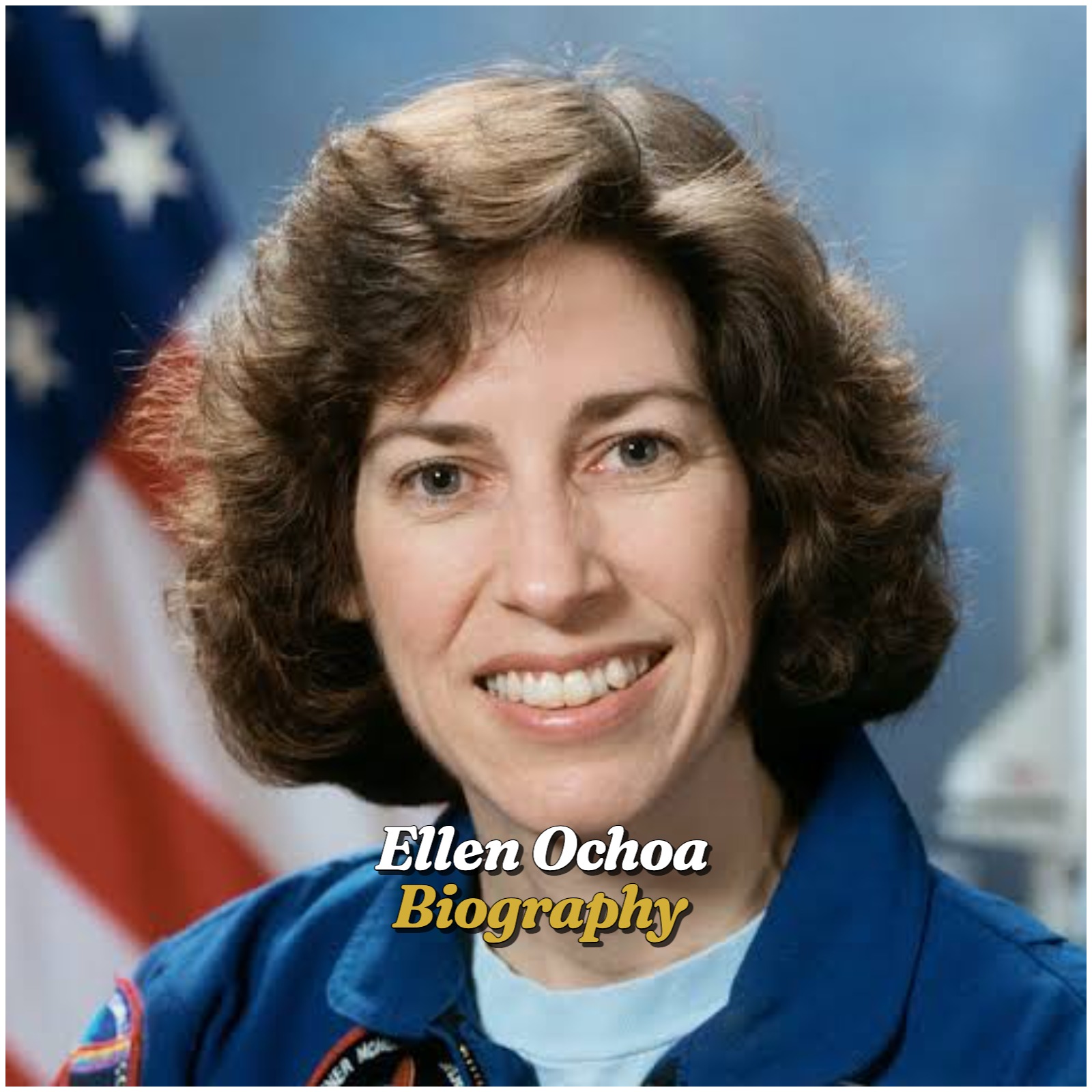
Ellen Lauri Ochoa is an American engineer, former NASA astronaut and former director of NASA’s Johnson Space Center. Born on May 10, 1958, in Los Angeles, California, Ochoa became the first Hispanic woman to travel to space when she flew aboard the Space Shuttle Discovery in 1993. She later became the first Hispanic director and the second woman to lead Johnson Space Center.
Ochoa developed a career that combined physics, electrical engineering, research, space exploration and leadership. Before becoming an astronaut, she worked as a research engineer at Sandia National Laboratories and NASA’s Ames Research Center, where she studied optical systems used for information processing. She also became a co inventor on three patents involving optical inspection, optical object recognition and image noise removal.
As an astronaut, Ochoa completed four space missions and spent nearly 1,000 hours in orbit. Her career later expanded into NASA management, where she served in several leadership positions before becoming director of Johnson Space Center in 2013. She retired from NASA in 2018 after three decades with the agency and has continued to advocate for education, STEM careers, leadership and greater participation by women and minorities in technical fields.
Ellen Ochoa’s Early Life
Ellen Lauri Ochoa was born on May 10, 1958, in Los Angeles, California, to Joseph and Rosanne Ochoa. Her paternal grandparents had immigrated from Sonora, Mexico, to Arizona and later California. Ochoa grew up in La Mesa, California, and was the middle child in a family of five children. Her parents did not have college degrees, but education eventually became a major part of her own life and career.
Ochoa attended Grossmont High School in La Mesa, California, graduating in 1975. During her teenage years, she had several interests and did not immediately know that she would pursue physics or engineering. She played the flute and was interested in music, at one point considering the possibility of becoming a music major. Her interest in science developed more strongly during her college years.
Her early interests eventually led her toward physics, mathematics and engineering. Ochoa discovered that she enjoyed using mathematics and physics to understand how the world worked, which influenced her decision to pursue a scientific career. She later developed expertise in optics and information processing, creating the foundation for the research career that eventually helped her become an astronaut.
Ellen Ochoa’s Education
Ellen Ochoa graduated from Grossmont High School in 1975 before attending San Diego State University. She earned a Bachelor of Science degree in physics from the university in 1980 and graduated Phi Beta Kappa. Her studies helped strengthen her interest in science and engineering and provided the academic foundation for her later research career.
After completing her undergraduate degree, Ochoa attended Stanford University, where she pursued graduate studies in electrical engineering. She earned a Master of Science degree in 1981 and a doctorate in electrical engineering in 1985. Her doctoral research focused on optics and information processing, areas that became central to her early professional work.
Ochoa’s academic achievements became an important part of her path toward NASA. Her research experience at Stanford, combined with her work in optical systems, gave her expertise in technology that could be applied to aerospace and spaceflight. She later received numerous honors for her contributions, including honorary doctorates and professional fellowships.
Ellen Ochoa’s Career
After completing her doctorate, Ellen Ochoa worked as a research engineer at Sandia National Laboratories and later at NASA’s Ames Research Center. Her work focused on optical systems for information processing. She became a co inventor on three patents and authored technical papers in her field. Ochoa joined NASA as a research engineer in 1988 and was selected as an astronaut in 1990.
Ochoa made history in 1993 when she traveled into space aboard the Space Shuttle Discovery for the STS 56 mission. She became the first Hispanic woman to go to space and served as a mission specialist. The mission studied the relationship between solar activity and Earth’s atmosphere, including the effects of solar energy on the planet’s climate and ozone layer.
She went on to fly three additional space shuttle missions. These included STS 66 aboard Atlantis in 1994, STS 96 aboard Discovery in 1999 and STS 110 aboard Atlantis in 2002. Across her four missions, she performed duties involving the shuttle’s robotic arm, scientific experiments and space station operations, spending nearly 1,000 hours in orbit.
Following her final spaceflight in 2002, Ochoa moved into increasingly senior management positions at NASA. She became deputy director of the Flight Crew Operations Directorate and later director of Flight Crew Operations. In 2013, she became the 11th director of Johnson Space Center, making her the first Hispanic person and the second woman to hold the position. During her leadership, she promoted an approach known as JSC 2.0 and oversaw major developments involving human spaceflight, Orion, the International Space Station and NASA workforce initiatives.
Ochoa retired from NASA in 2018 after 30 years with the agency. Since then, she has remained involved in leadership, education and STEM advocacy. She serves on boards and has continued speaking to audiences about science, technology, engineering and mathematics, while encouraging women and minorities to pursue technical careers.
Ellen Ochoa’s 2026 Leadership Lessons From Space Conversation
Ellen Ochoa attracted renewed attention in 2026 through a Stanford Technology Ventures Program conversation titled “Leadership Lessons from Space.” The May 20, 2026 discussion focused on lessons she gained from space exploration and NASA leadership, including exploration, resilience, purpose and teamwork.
The conversation highlighted Ochoa’s continued involvement in sharing her experiences decades after her astronaut career ended. Her professional journey from electrical engineering research to four space missions and eventually leadership of Johnson Space Center provided the basis for discussing decision making, teamwork and navigating complex challenges.
Ochoa has also continued to promote STEM education and greater participation by women and minorities in technical fields. Her public speaking and educational work remain a significant part of her activities after NASA, with her official biography noting that she has delivered more than 300 presentations and has supported initiatives encouraging young people to pursue science and engineering.
Ellen Ochoa’s Personal Life
Ellen Ochoa is married to Coe Miles, an intellectual property attorney. The couple have two sons. Ochoa has described her family as an important consideration in her decision to retire from NASA in 2018, when her youngest son had turned 18 and she felt it was a natural point for the family to move into another phase of life.
Outside her scientific and aerospace career, Ochoa has maintained a strong interest in music. She is a classical flutist and has played the flute since childhood. During her first space mission in 1993, she even played the flute aboard the Space Shuttle Discovery, demonstrating that her interests extended beyond science and engineering.
Ochoa has also remained active in public education and leadership. She has participated in numerous presentations and educational initiatives and has supported efforts encouraging young people, particularly women and minorities, to pursue STEM careers. Her work has also been recognized through schools, educational materials and professional organizations bearing or highlighting her name.
Ellen Ochoa’s Age, Religion, Nationality, Height and Physical Appearance
Ellen Ochoa was born on May 10, 1958, making her 68 years old in 2026. She was born in Los Angeles, California, and grew up in La Mesa, California. She is American by nationality.
Ochoa’s personal religious beliefs have not been reliably documented in the major biographical sources reviewed for this biography. Her family background includes Mexican ancestry through her paternal grandparents, but ancestry does not establish a person’s personal religion.
Ellen Ochoa’s exact height is not consistently documented in authoritative biographical records. She has a slim build and is recognizable by her dark hair and distinctive professional appearance. Photographs from her NASA career show her throughout her astronaut and leadership years.
Ellen Ochoa’s Net Worth
Ellen Ochoa’s exact net worth has not been publicly confirmed. Unlike many entertainment personalities, her career was primarily built through engineering, NASA service, scientific research and executive leadership, making her personal financial information less publicly documented.
Her professional income has included decades of work at NASA, where she progressed from research engineer to astronaut and eventually director of Johnson Space Center. She has also served on boards and undertaken leadership and speaking activities following her retirement from NASA.
Based on her decades of senior scientific and executive work, an unofficial estimate of $5 million to $10 million can be used for her 2026 net worth. This is an estimate rather than a verified figure, as Ochoa has not publicly disclosed a precise personal net worth.
Ellen Ochoa’s Legacy
Ellen Ochoa’s legacy is closely connected to her historic achievement as the first Hispanic woman to travel to space. Her 1993 mission made her a prominent figure in the history of human spaceflight and provided representation for Hispanic women in science, engineering and aerospace. She subsequently completed three more space missions and accumulated nearly 1,000 hours in orbit.
Her influence also extends beyond her astronaut career. Ochoa became the first Hispanic director of Johnson Space Center and the second woman to lead the facility. During her leadership, she worked on human spaceflight programs, organizational changes, innovation and inclusion initiatives.
Education and STEM advocacy remain central to Ochoa’s continuing legacy. She has delivered hundreds of presentations, supported educational initiatives and encouraged young people to consider careers in science and technology. Her name has been given to multiple schools, while her story has appeared in educational books and materials designed to introduce young students to STEM.
Conclusion
Ellen Ochoa’s journey from a California student interested in music and science to an electrical engineer, NASA astronaut and Johnson Space Center director is one of the most notable careers in American space exploration. Her four space missions, historic achievement as the first Hispanic woman in space, NASA leadership and continuing commitment to STEM education have kept her influence active long after her retirement from the agency. At 68, Ochoa continues to share the lessons of her experiences and encourage a new generation to pursue science, technology, engineering and mathematics.
Frequently Asked Questions About Ellen Ochoa
Who is Ellen Ochoa?
Ellen Ochoa is an American engineer, former NASA astronaut and former director of NASA’s Johnson Space Center.
How old is Ellen Ochoa?
Ellen Ochoa is 68 years old in 2026. She was born on May 10, 1958.
Where was Ellen Ochoa born?
Ellen Ochoa was born in Los Angeles, California, United States.
What is Ellen Ochoa famous for?
Ellen Ochoa is famous for becoming the first Hispanic woman to travel to space in 1993 and later becoming the first Hispanic director of NASA’s Johnson Space Center.
When did Ellen Ochoa go to space?
Ellen Ochoa first traveled to space in 1993 aboard the Space Shuttle Discovery during the STS 56 mission.
How many times did Ellen Ochoa go to space?
Ellen Ochoa flew into space four times between 1993 and 2002.
How many hours did Ellen Ochoa spend in space?
Ellen Ochoa spent nearly 1,000 hours in space across her four NASA missions.
What spacecraft did Ellen Ochoa fly on?
Ellen Ochoa flew aboard the Space Shuttle Discovery and Space Shuttle Atlantis during her four space missions.
What did Ellen Ochoa study?
Ellen Ochoa studied physics at San Diego State University and electrical engineering at Stanford University.
Where did Ellen Ochoa go to college?
Ellen Ochoa attended San Diego State University and Stanford University.
What degrees does Ellen Ochoa have?
Ellen Ochoa earned a Bachelor of Science degree in physics from San Diego State University and master’s and doctoral degrees in electrical engineering from Stanford University.
Who is Ellen Ochoa’s husband?
Ellen Ochoa is married to Coe Miles, an intellectual property attorney.
Does Ellen Ochoa have children?
Yes. Ellen Ochoa and her husband, Coe Miles, have two sons.
What is Ellen Ochoa’s nationality?
Ellen Ochoa is American.
What is Ellen Ochoa’s religion?
Ellen Ochoa’s personal religion has not been reliably confirmed in major public biographical sources.
How tall is Ellen Ochoa?
Ellen Ochoa’s exact height has not been consistently documented in authoritative public biographical sources.
When did Ellen Ochoa join NASA?
Ellen Ochoa joined NASA as a research engineer in 1988 and was selected as an astronaut in 1990.
When did Ellen Ochoa become an astronaut?
Ellen Ochoa was selected for NASA’s astronaut program in 1990.
When did Ellen Ochoa become director of Johnson Space Center?
Ellen Ochoa became director of NASA’s Johnson Space Center in 2013 and served until her retirement in 2018.
What did Ellen Ochoa do after retiring from NASA?
After retiring from NASA in 2018, Ellen Ochoa continued working in leadership, education, STEM advocacy, public speaking and organizational activities.
What is Ellen Ochoa’s net worth?
Ellen Ochoa’s exact net worth has not been publicly confirmed. An unofficial 2026 estimate places her net worth between $5 million and $10 million based on her decades of engineering, NASA leadership, board and professional work.
What is Ellen Ochoa’s legacy?
Ellen Ochoa’s legacy includes becoming the first Hispanic woman in space, completing four space missions, becoming the first Hispanic director of Johnson Space Center and advocating for women and minorities in STEM fields.