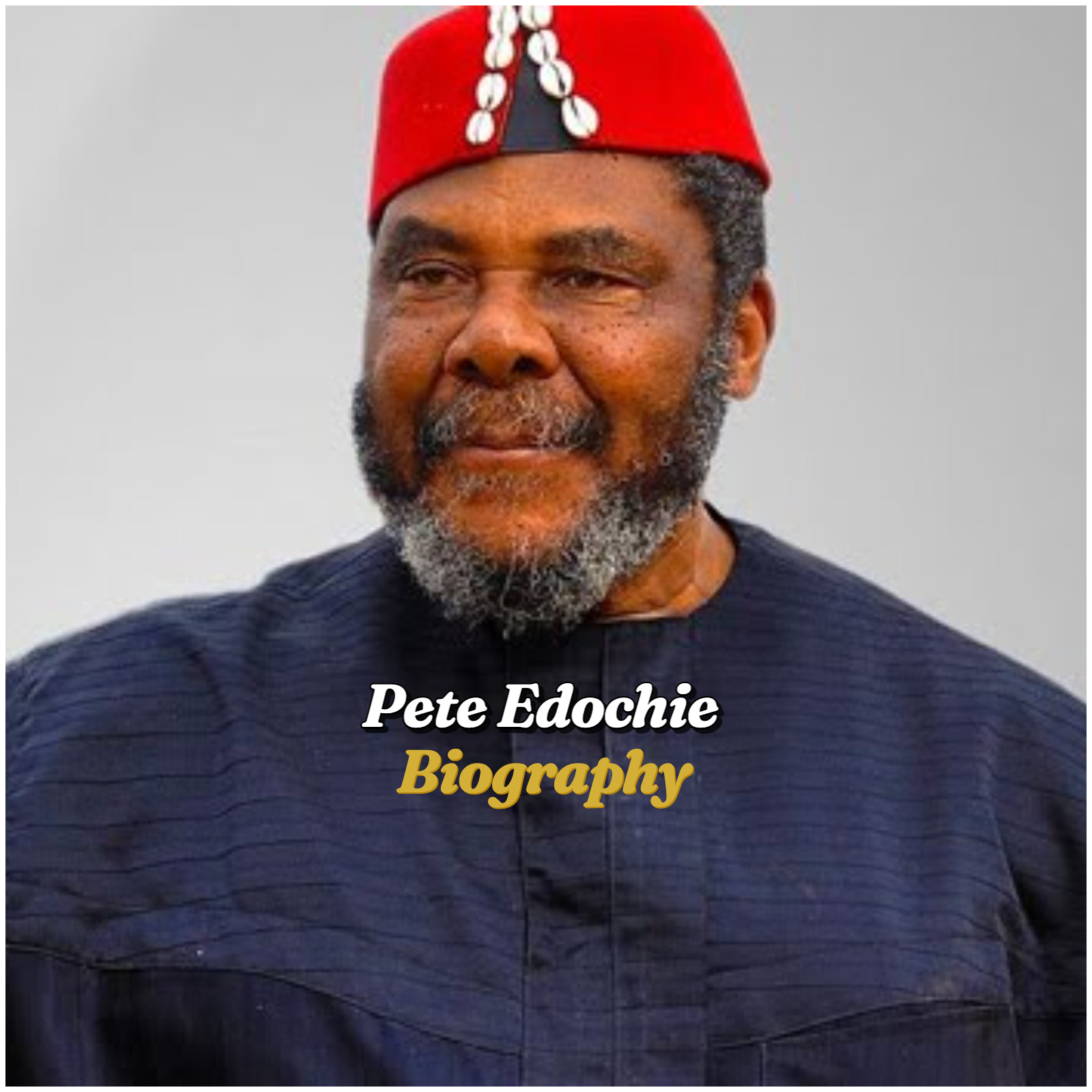
Chief Pete Edochie (1947–2026) was a legendary Nigerian actor and veteran broadcaster widely regarded as one of the most influential figures in the history of Nollywood. Born on March 7, 1947, in Anambra State, Nigeria, he earned widespread recognition for his commanding screen presence, distinctive deep voice, powerful acting performances, and mastery of traditional African storytelling. He became a household name across Africa following his iconic portrayal of Okonkwo in the 1987 television adaptation of Chinua Achebe’s celebrated novel, Things Fall Apart. His contribution to Nigerian entertainment established him as a respected figure whose influence extended across generations of actors and filmmakers.
Before achieving fame in the Nigerian film industry, Edochie built a successful career in broadcasting, working with the Eastern Nigerian Broadcasting Corporation and later rising to senior management positions. His transition into acting opened the door to a remarkable entertainment career that included appearances in several popular Nigerian productions, such as Igodo, Rituals, and Lionheart. Throughout his career, he became particularly recognised for portraying traditional rulers, wealthy patriarchs, community leaders, and authoritative family figures. His achievements earned him several honours, including the Member of the Order of the Niger (MON), as well as industry recognition for his lasting contribution to African cinema.
Pete Edochie’s life and career attracted renewed public attention following reports of his death on November 25, 2026, at the age of 79, after a prolonged battle with prostate cancer, according to a family announcement. His passing marked the end of an extraordinary journey that spanned broadcasting, television drama, and Nigerian cinema. Beyond his professional achievements, he was a devoted husband to Josephine Edochie and the father of six children, including popular Nollywood actor Yul Edochie. Remembered for his remarkable performances, cultural influence, and contribution to the growth of Nollywood, Pete Edochie left behind a legacy that continues to hold an important place in African entertainment history.
Pete Edochie Early Life
Pete Edochie was born on March 7, 1947, in Zaria, Kaduna State, Nigeria, although he hailed from Ifite Nteje in Anambra State, southeastern Nigeria. He grew up in a family environment that exposed him to traditional Igbo values, cultural practices, and the importance of discipline and respect. His early experiences in northern Nigeria and his ancestral connection to Anambra State contributed to his understanding of Nigerian culture and society, which later became evident in his acting performances. From an early age, he developed an interest in communication and storytelling, interests that would eventually influence his professional journey.
During his childhood, Edochie received his primary education in Zaria before proceeding to St. John’s College in Kaduna for his secondary education. He was known to have developed an interest in radio broadcasting while growing up, partly influenced by his father’s habit of listening to the British Broadcasting Corporation (BBC). He also admired American entertainer Elvis Presley and reportedly imitated his hairstyle and dance movements as a young boy. These early interests reflected his growing fascination with entertainment, communication, and performance, although his eventual career would take a different direction from music.
After completing his secondary education in 1964, Edochie began working with the Nigerian Railway Corporation in the accounts department. However, his growing passion for broadcasting eventually encouraged him to pursue opportunities in the media industry. His decision to leave his initial employment and explore broadcasting marked an important turning point in his life. In February 1967, he joined the Eastern Nigerian Broadcasting Corporation as a junior programmes assistant, beginning a professional journey that would later establish him as a respected broadcaster before his transition into acting and his eventual rise to prominence in Nollywood.
Pete Edochie Education
Pete Edochie began his formal education in Zaria, Kaduna State, Nigeria, where he completed his primary schooling. Growing up in northern Nigeria, he developed an early interest in communication and broadcasting, partly influenced by his father’s habit of listening to radio programmes from the British Broadcasting Corporation (BBC). His exposure to radio broadcasting during his formative years helped shape his interest in the media and entertainment industry, eventually influencing his decision to pursue a career in broadcasting.
After completing his primary education, Edochie proceeded to St. John’s College in Kaduna, where he received his secondary education. He attended the institution until 1964, when he completed his secondary schooling. During this period, he developed an interest in entertainment and communication, while also admiring American singer and actor Elvis Presley. His fascination with radio, public communication, and performance gradually influenced his professional ambitions, although he did not initially pursue an acting career.
Following his secondary education, Edochie did not immediately proceed to a university but instead entered the workforce, joining the Nigerian Railway Corporation’s accounts department. His interest in broadcasting eventually led him to pursue professional opportunities in the media industry. In 1967, he joined the Eastern Nigerian Broadcasting Corporation as a junior programmes assistant, beginning a broadcasting career that included professional training at the British Broadcasting Corporation (BBC) in 1980. His practical experience and subsequent professional development helped establish the communication skills and commanding voice that later became defining features of his successful acting career.
Pete Edochie Career
Pete Edochie began his professional career in broadcasting in February 1967 when he joined the Eastern Nigerian Broadcasting Corporation as a junior programmes assistant. His interest in radio and communication had developed during his childhood, and he gradually established himself within the broadcasting industry through dedication and professional experience. During the Nigerian Civil War, he also worked with the Voice of Biafra, contributing to wartime broadcasting. Over the years, he advanced through several positions and became recognised for his distinctive voice, communication skills, and understanding of media production. His broadcasting career provided a strong professional foundation that would later support his transition into acting.
As his experience in broadcasting expanded, Edochie took on increasingly important responsibilities within the media industry. In 1980, he received professional training at the British Broadcasting Corporation (BBC), further developing his broadcasting knowledge and skills. He subsequently became the first director of ABS 3 FM Stereo in Enugu in 1987 and held other senior management positions, including Director of Programmes and Deputy Managing Director. Although broadcasting had established his professional reputation, his interest in entertainment and performance eventually opened the door to a career that would make him one of Nigeria’s most recognisable actors.
Edochie’s major breakthrough in acting came in 1987 when he portrayed Okonkwo in the Nigerian Television Authority’s adaptation of Chinua Achebe’s celebrated novel, Things Fall Apart. His commanding performance brought him widespread recognition across Nigeria and other African countries. His interpretation of the complex character, combined with his deep voice, powerful delivery, and ability to communicate traditional African values, made the production particularly memorable. The success of Things Fall Apart established him as a respected television actor and created opportunities for him to become one of the leading figures in Nigeria’s emerging film industry. His portrayal of Okonkwo remains one of the most celebrated performances in the history of Nigerian television drama.
Following his breakthrough, Pete Edochie became a prominent figure in Nollywood, appearing in numerous Nigerian films and establishing a reputation for portraying influential traditional rulers, wealthy businessmen, family patriarchs, and community leaders. Some of his notable productions include Igodo, Rituals, Billionaire’s Club, and Lionheart. His acting style was characterised by authority, emotional depth, expressive dialogue, and frequent use of traditional Igbo proverbs. These qualities made him particularly popular among audiences who appreciated his ability to represent African cultural values through film. Over the years, he worked alongside several generations of Nigerian actors and became an influential presence in the development of the country’s entertainment industry.
Throughout his distinguished career, Edochie received numerous awards and honours in recognition of his contributions to broadcasting and African cinema. In 2003, he was conferred with the national honour of Member of the Order of the Niger (MON) by President Olusegun Obasanjo. He also received the Africa Movie Academy Awards Lifetime Achievement Award and the Industry Merit Award at the 2014 Africa Magic Viewers’ Choice Awards. His career achievements reflected decades of dedication to storytelling, broadcasting, and acting. Until his reported death on November 25, 2026, at the age of 79, Pete Edochie remained one of the most respected veterans of Nollywood, leaving behind an enduring body of work that influenced generations of African performers and filmmakers.
Pete Edochie Death at 79 After Battle with Prostate Cancer
Pete Edochie became the subject of widespread national and international attention on November 25, 2026, following the announcement of his death at the age of 79. The veteran Nigerian actor and broadcaster reportedly died at 12:30 a.m. in Enugu after a prolonged battle with prostate cancer. His passing was announced by his son, Chief Leo Pete Edochie, in a family statement titled “An Iroko Has Fallen,” shared on behalf of the family. The announcement prompted an outpouring of condolences from Nigerians, entertainment personalities, political leaders, and admirers of his work across Africa.
News of Edochie’s death attracted particular attention because of his remarkable contribution to Nigerian entertainment over several decades. He was widely regarded as one of the most influential actors in Nollywood, having gained international recognition for his portrayal of Okonkwo in the television adaptation of Chinua Achebe’s Things Fall Apart. His distinctive voice, commanding screen presence, and memorable interpretation of traditional African characters made him a household name. His passing represented a significant loss to the Nigerian film industry, particularly among audiences who had followed his career from its early television productions.
His death also renewed public interest in his health struggles and final public appearances. In October 2026, Edochie visited Ghana, where he met fellow actor Emmanuel Armah and appeared on TV3’s The Afternoon Show. During his visit, he spoke about experiencing physical difficulties, including problems with walking and swelling in parts of his body. He also discussed his health challenges and expressed hope for recovery. These appearances became particularly emotional for his admirers following the subsequent announcement that he had died after battling prostate cancer.
Another development that attracted attention shortly before his death was his interview discussing his son, Yul Edochie, and the public criticism surrounding Yul’s personal life. Pete defended his son against some of the criticism he had received following his second marriage to actress Judy Austin. His comments generated conversations across social media, bringing renewed attention to the Edochie family. The interview became one of the notable public discussions associated with the veteran actor during the final days of his life.
Following the announcement, tributes began pouring in from prominent Nigerians, including Enugu State Governor Peter Mbah, who described Edochie’s death as the loss of a giant, icon, and patriot. The governor praised his contribution to Nigerian cinema and his role in promoting Igbo culture through storytelling and acting. The family confirmed that he was survived by his wife, Barrister Josephine Edochie, his children, siblings, and other relatives, while funeral arrangements were expected to be announced later. His death on November 25, 2026, marked the end of an extraordinary career and renewed appreciation for the legacy of an actor whose performances helped shape Nollywood and African cinema.
Pete Edochie Personal Life and Family
Pete Edochie was married to Barrister Josephine Edochie, whom he married in 1969 at St. Finbarr’s Catholic Church in Umuahia, Nigeria. Their marriage lasted 57 years, making them one of the long-married couples associated with the Nigerian entertainment industry. Josephine was a broadcaster before pursuing a career in law, and she reportedly worked alongside Pete at the Eastern Nigerian Broadcasting Corporation when they began their professional journeys in 1967. Throughout their marriage, she remained an important part of his personal life, supporting him through his transition from broadcasting into acting and his eventual rise to prominence in Nollywood. Pete frequently expressed his affection and appreciation for his wife, describing her as his queen and celebrating their enduring relationship publicly.
Pete and Josephine Edochie had six biological children, consisting of five sons and one daughter: Leo, Adam, Linc, Jean, Yul, and Eva Edochie. Among their children, Yul and Linc became particularly recognised for following their father’s footsteps into the Nigerian entertainment industry. Yul Edochie established himself as a successful Nollywood actor and filmmaker, while Linc Edochie also pursued acting, scriptwriting, and film production. Their eldest son, Leo Pete Edochie, became known as a businessman and was the family member who announced his father’s death on November 25, 2026. Pete also had numerous grandchildren, and he occasionally expressed pride in the family he had built with Josephine. Their daughter, Eva, maintained a relatively private lifestyle away from the entertainment industry.
Beyond his professional achievements, Edochie valued his responsibilities as a husband and father and generally maintained a protective approach towards his family’s privacy. However, his family occasionally attracted public attention, particularly following controversies surrounding Yul Edochie’s second marriage to actress Judy Austin and the public disagreements involving his first wife, May Yul-Edochie. Pete publicly defended his son during interviews, expressing his views about the criticism Yul had received. Despite the public attention surrounding some family matters, Pete’s marriage to Josephine and their six children remained central to his personal story. Following his death at the age of 79 on November 25, 2026, he was survived by his wife, children, grandchildren, siblings, and other relatives, leaving behind a family legacy alongside his remarkable contribution to Nigerian entertainment.
Pete Edochie Age, Religion, Tribe, Height and Physical Appearance
Pete Edochie was born on March 7, 1947, in Zaria, Kaduna State, Nigeria, and reportedly died on November 25, 2026, at the age of 79 in Enugu following a prolonged battle with prostate cancer. He was a Nigerian national whose ancestral roots were in Ifite Nteje, Anambra State, southeastern Nigeria. Throughout his life, he maintained a strong connection to his Igbo heritage, which influenced his personal identity and professional career. His cultural background was particularly evident in his acting performances, where he frequently incorporated Igbo proverbs, traditional expressions, customs, and storytelling into his characters.
Edochie was a devoted Christian of the Roman Catholic faith. He was raised in a Catholic household, and his religious background remained an important part of his personal life. On March 19, 1969, he married his wife, Barrister Josephine Edochie, at St. Finbarr’s Catholic Church in Umuahia. His public discussions about family, discipline, morality, and traditional values often reflected the principles associated with his upbringing and personal beliefs. Although he became internationally recognised for portraying traditional African characters, his Christian faith was an important aspect of his identity outside the entertainment industry.
Pete Edochie’s exact height was not officially confirmed in authoritative public records, although some entertainment profiles commonly estimate it at approximately 5 feet 9 inches (175 cm). He was widely recognised for his commanding physical presence, dark complexion, broad facial features, and distinctive deep baritone voice. His dignified posture and authoritative appearance made him particularly suited to portraying traditional chiefs, kings, wealthy patriarchs, and respected elders in Nollywood productions. He was frequently seen wearing flowing traditional Igbo garments, traditional caps, and cultural regalia, which complemented his strong screen personality and helped establish his recognisable image in Nigerian cinema.
Pete Edochie Net Worth
Pete Edochie’s estimated net worth was approximately $4 million at the time of his death in November 2026. Although he never publicly disclosed his total wealth, his financial success was largely attributed to his decades-long career as a veteran Nollywood actor and broadcaster. His popularity, reputation, and extensive experience in the Nigerian entertainment industry enabled him to command substantial payments for acting roles, alongside earnings from television appearances, endorsements, and other professional engagements. Estimates of his wealth vary, and the figure should be treated as an approximation rather than a confirmed financial valuation.
A significant portion of Edochie’s wealth came from his successful acting career, which expanded considerably after his portrayal of Okonkwo in Things Fall Apart. In an interview, he revealed that his first movie payment was ₦50,000, compared with his previous monthly broadcasting salary of ₦9,000. He also disclosed that he earned approximately ₦750,000 during his first year as a full-time actor. As his reputation grew, he became one of the respected veteran performers in Nollywood, securing numerous film roles and benefiting from his established position in the industry. His long broadcasting career, brand endorsements, and professional appearances also contributed to his overall earnings.
Beyond his entertainment income, Edochie was believed to have accumulated personal assets and property throughout his career. His financial achievements reflected decades of professional work, financial stability, and his standing as one of Nigeria’s most recognisable entertainment personalities. Although detailed information about his investments, properties, and other financial holdings was not publicly available, his estimated $4 million fortune represents the considerable success he achieved through broadcasting and acting. Following his death at the age of 79, his financial legacy became another aspect of the remarkable career he left behind.
Pete Edochie Legacy
Pete Edochie left behind an extraordinary legacy as one of the most influential actors in Nigerian entertainment history. Widely celebrated for his commanding performances, distinctive baritone voice, and mastery of traditional African storytelling, he helped shape the identity of Nollywood and introduced Nigerian television drama to audiences across Africa and beyond. His iconic portrayal of Okonkwo in the 1987 adaptation of Chinua Achebe’s Things Fall Apart remains one of the most memorable performances in African television history. Through his ability to portray traditional rulers, community elders, wealthy patriarchs, and influential leaders, he became a respected symbol of cultural representation and excellence in Nigerian cinema.
Beyond his acting achievements, Edochie’s legacy includes his contributions to broadcasting, mentorship, and the preservation of Igbo cultural heritage. His extensive experience in the media industry and his transition from broadcasting to acting demonstrated his versatility and dedication to storytelling. Throughout his career, he inspired younger generations of Nigerian actors, including his sons Yul and Linc Edochie, while working alongside numerous established and emerging performers. His frequent use of Igbo proverbs, traditional expressions, and cultural customs in his movie roles helped introduce important aspects of southeastern Nigerian heritage to wider audiences. His achievements were recognised through several honours, including the Member of the Order of the Niger (MON) and the Africa Magic Viewers’ Choice Awards Industry Merit Award.
Following his reported death on November 25, 2026, at the age of 79, Pete Edochie’s influence continues to represent an important chapter in the history of African entertainment. His body of work, memorable performances, and contribution to the development of Nollywood remain significant parts of his professional legacy. Beyond the screen, he will be remembered as a devoted husband to Josephine Edochie, a father of six children, and a public figure who maintained a strong connection to his cultural roots. Through the characters he portrayed and the generations of performers he influenced, Edochie secured a lasting place in Nigerian cinema as an actor whose work helped define the meaning of African storytelling.
Conclusion
Pete Edochie (1947–2026) will be remembered as one of Nigeria’s most celebrated actors and influential figures in African entertainment. From his early career in broadcasting to his legendary portrayal of Okonkwo in Things Fall Apart, he built an extraordinary career that helped shape the growth of Nollywood and brought Nigerian storytelling to international audiences. His distinctive voice, commanding performances, dedication to Igbo cultural heritage, and contribution to the entertainment industry earned him lasting respect across generations. Beyond his professional achievements, his marriage to Josephine Edochie and his role as a father of six children formed important parts of his personal legacy. Although his death on November 25, 2026, marked the end of his remarkable journey, his films, cultural influence, and contribution to Nigerian cinema will continue to inspire audiences and future generations of African actors.
Frequently Asked Questions About Pete Edochie
1. Who was Pete Edochie?
Pete Edochie was a legendary Nigerian actor and veteran broadcaster best known for his portrayal of Okonkwo in the 1987 television adaptation of Chinua Achebe’s Things Fall Apart. He was widely respected for his commanding acting style, distinctive voice, and contribution to Nollywood.
2. How old was Pete Edochie when he died?
Pete Edochie was 79 years old when he reportedly died on November 25, 2026. He was born on March 7, 1947, in Zaria, Kaduna State, Nigeria.
3. What was Pete Edochie’s cause of death?
Pete Edochie reportedly died following a prolonged battle with prostate cancer. His death was announced by his family on November 25, 2026.
4. Who was Pete Edochie’s wife?
Pete Edochie’s wife was Barrister Josephine Edochie. They got married on March 19, 1969, at St. Finbarr’s Catholic Church in Umuahia, and their marriage lasted 57 years.
5. How many children did Pete Edochie have?
Pete Edochie had six children with his wife, Josephine Edochie. Their children are Leo, Adam, Linc, Jean, Yul, and Eva Edochie. His sons Yul and Linc became involved in the Nigerian entertainment industry.
6. What was Pete Edochie’s most famous movie?
Pete Edochie’s most famous production was Things Fall Apart, in which he portrayed Okonkwo in 1987. The performance established him as one of Nigeria’s most recognisable actors and remains a defining moment in his career.
7. What was Pete Edochie’s net worth?
Pete Edochie’s estimated net worth was approximately $4 million at the time of his death in 2026. His wealth was attributed to his long career in Nollywood, broadcasting, film appearances, endorsements, and other professional engagements. This figure is an estimate rather than a confirmed financial valuation.
8. What was Pete Edochie’s tribe and state of origin?
Pete Edochie belonged to the Igbo ethnic group of southeastern Nigeria. He hailed from Ifite Nteje in Oyi Local Government Area of Anambra State, although he was born in Zaria, Kaduna State.
9. What religion did Pete Edochie practise?
Pete Edochie was a Christian of the Roman Catholic faith. He was raised in a Catholic household and married his wife at St. Finbarr’s Catholic Church in Umuahia in 1969.
10. What was Pete Edochie’s height?
Pete Edochie’s height was commonly estimated at approximately 5 feet 9 inches (175 cm), although this measurement was not officially confirmed in authoritative public records.
11. Who is Pete Edochie’s most famous son?
Yul Edochie is Pete Edochie’s most widely recognised son in Nollywood. He followed his father’s footsteps into acting and established himself as a Nigerian actor, filmmaker, and public personality. Another son, Linc Edochie, also works in the entertainment industry.
12. What awards did Pete Edochie receive?
Pete Edochie received several honours during his career, including the Member of the Order of the Niger (MON) in 2003, the Africa Magic Viewers’ Choice Awards Industry Merit Award in 2014, and a Lifetime Achievement Award from the Africa Movie Academy Awards. These recognitions celebrated his contributions to Nigerian broadcasting and African cinema.