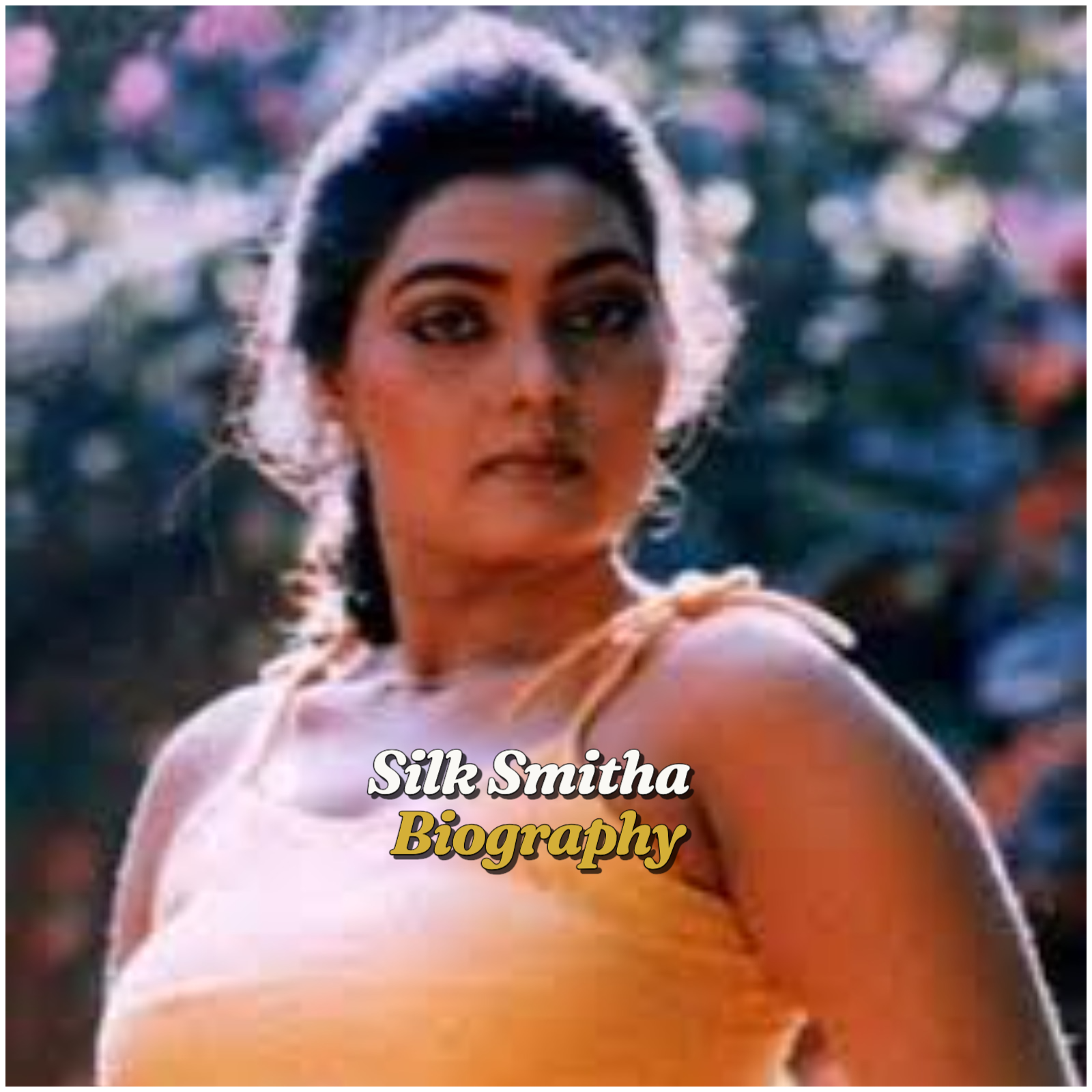
Silk Smitha, born Vadlapati Vijayalakshmi, was an Indian actress and dancer who became one of the most recognizable and sought-after performers in South Indian cinema during the 1980s and early 1990s. Known for her glamorous screen presence, dance performances and bold roles, she worked predominantly in Tamil, Telugu, Malayalam and Kannada films, with some appearances in Hindi cinema. Over a career of roughly 17 to 18 years, she appeared in more than 400 films, although published counts vary, making her one of the most prolific performers of her generation.
Born into poverty in Andhra Pradesh, Vijayalakshmi left school after the fourth standard and entered adulthood under difficult circumstances. She was married at a very young age and later left the marriage after reportedly facing mistreatment. After moving to Madras, now Chennai, she initially worked as a touch-up makeup artist before being given opportunities in films. Her transformation from a struggling young woman into a major screen attraction became one of the most remarkable stories in South Indian cinema.
Smitha’s popularity was closely associated with the sensual dance numbers and glamorous characters that became a major part of commercial South Indian cinema in the 1980s. At the same time, she demonstrated that she could perform in more conventional dramatic roles, particularly in films such as Alaigal Oivathillai and Moondram Pirai. Her tragic death at the age of 35 added another layer to her legend, while later films such as The Dirty Picture introduced her story and image to a new generation.
Silk Smitha Profile Summary
| Profile | Details |
|---|---|
| Full Name | Vadlapati Vijayalakshmi |
| Stage Name | Silk Smitha |
| Born | December 2, 1960 |
| Birthplace | Eluru district, Andhra Pradesh, India |
| Died | September 23, 1996 |
| Age at Death | 35 |
| Occupation | Actress and dancer |
| Years Active | 1979–1996 |
| Languages/Industries | Tamil, Telugu, Malayalam, Kannada and Hindi cinema |
| Religion | Hinduism |
| Nationality | Indian |
| Height | Reported as approximately 170 cm |
| Marital Status | Previously married |
| Known For | Glamorous roles, dance numbers and South Indian cinema |
| None, as she died before the social-media era | |
| Net Worth at Death | Not reliably established |
Silk Smitha Early Life
Silk Smitha was born Vadlapati Vijayalakshmi on December 2, 1960, in the Eluru area of present-day Andhra Pradesh. Sources identify her parents as Ramallu and Sarasamma, and some accounts place her birthplace specifically in Kovvali village. She grew up in a Telugu-speaking family with very limited financial resources. Poverty had a major effect on her education, and she left school after the fourth standard.
Her childhood was far removed from the glamour associated with her later career. Accounts of her early years describe a family struggling financially and a young Vijayalakshmi who became determined to find a different life. Her striking appearance attracted attention, but her early circumstances gave her few opportunities to pursue formal education. She was reportedly married while still very young, around the age of 14, and later left the marriage after experiencing mistreatment from her husband and his family.
After leaving her marriage, she worked to support herself before moving to Madras, then the centre of the South Indian film industry. She initially found work as a touch-up artist, helping actresses with makeup. That position brought her closer to the film world and eventually opened the door to acting. Her transition from makeup work to acting marked the beginning of the career that would make her famous across several Indian film industries.
Silk Smitha Education
Silk Smitha had very little formal education. Because of her family’s financial circumstances, she left school after completing the fourth standard. Consequently, unlike many later film personalities, she did not have a secondary-school or university education to list as part of her professional biography.
Her lack of formal education did not prevent her from developing skills that became important to her career. After entering the film industry, she learned through practical experience, observation and the guidance of people working around her. Director Vinu Chakravarthy and his wife reportedly helped her learn English and arranged dancing lessons as she developed her abilities as a performer.
Much of Smitha’s professional education therefore came from the film industry itself. She learned acting, dance, presentation and the demands of commercial cinema while working alongside established actors, directors and technicians. Her ability to adapt to different roles helped her build a career across several South Indian languages despite her limited formal schooling.
Silk Smitha Career
Silk Smitha’s Entry Into Cinema
Smitha entered the entertainment industry through makeup work before receiving opportunities to appear in films. Malayalam filmmaker Antony Eastman gave her an early acting opportunity and reportedly gave her the name “Smitha.” Her film Inaye Thedi was made earlier in her career and eventually released in 1981, establishing one of her first significant acting credits.
Her major breakthrough came with the Tamil film Vandichakkaram. She played a character named Silk, and the role became closely associated with her own screen identity. After the film attracted attention, she adopted the name Silk Smitha. Although sources differ over whether the film should be dated to 1979 or 1980, it is consistently identified as the role that established the “Silk” name and launched her into wider recognition.
Rise to Stardom
The success of Vandichakkaram led to a dramatic expansion of Smitha’s career. Her appearance, dance ability and confident screen presence made her particularly popular in glamorous roles and song sequences. She became so commercially valuable that her presence in a film or dance number could be used as a promotional attraction, and distributors sometimes wanted her involvement to increase audience interest.
Her career extended across Tamil, Telugu, Malayalam and Kannada cinema, with occasional Hindi work. Sources place the number of films in which she appeared at more than 400, with some accounts giving a figure above 450. Her extraordinarily busy schedule reflected the demand for her performances during the peak of her popularity.
Acting Beyond Glamorous Roles
Although Smitha became strongly associated with erotic and glamorous performances, her filmography was not limited to such roles. She received attention for her performance in Alaigal Oivathillai (1981), demonstrating that she could work in more conventional dramatic parts. She also appeared in Balu Mahendra’s acclaimed Moondram Pirai, alongside Kamal Haasan and Sridevi.
Moondram Pirai became particularly important to her reputation because it allowed audiences to see her outside the narrow image of the glamorous dancer. The film was later remade in Hindi as Sadma, with Kamal Haasan and Sridevi, while Smitha also appeared in the original Tamil production. Her participation in respected dramatic cinema remains an important part of discussions about her acting career.
Dance Numbers and Screen Image
Dance performances were central to Smitha’s popularity. During the 1980s, South Indian commercial cinema frequently featured glamorous dance sequences, and Smitha became one of the most recognizable performers associated with that trend. Her screen image eventually became so strong that audiences often associated the name Silk Smitha with sensuality, glamour and dance even when she appeared in relatively small roles.
This popularity also created limitations. Because producers repeatedly cast her in similar roles, she became heavily typecast. Her commercial value was tied closely to her physical appearance and screen persona, making it more difficult for her to demonstrate the full range of her acting abilities. Contemporary and later commentary on her career has therefore examined both her enormous popularity and the ways in which the industry reduced her to a particular screen image.
Silk Smitha as a Film Producer
Towards the end of her career, Smitha attempted to move beyond acting and become involved in film production. The transition exposed her to significant financial risk. Accounts published after her death say that she invested substantial amounts of money into film projects that did not produce the expected returns. One reported account estimated that she lost more than four crore rupees through several productions.
Her production ventures contributed to the financial difficulties surrounding the final period of her life. However, later accounts sometimes combine financial losses, relationship problems and alcohol use into a single explanation for her death. Those explanations should be treated cautiously because the exact circumstances surrounding her final months remain incompletely documented.
Silk Smitha Trending: Why Is Silk Smitha Famous?
Silk Smitha remains famous because she became one of the defining screen personalities of 1980s South Indian cinema. Her combination of dance, glamour and screen confidence made her a major commercial attraction, while her enormous filmography ensured that her performances reached audiences across several languages. She also became an example of how actresses who were heavily marketed for sensuality could become both extremely successful and heavily typecast.
Her fame continued after her death because her story became part of Indian popular culture. The 2011 Hindi film The Dirty Picture, starring Vidya Balan, drew heavily on the image and career of Silk Smitha. However, the filmmakers later clarified that the movie was not a literal biography of Smitha and that the character also drew from other actresses of the period, including Disco Shanti.
The film nonetheless renewed national interest in Smitha. It introduced aspects of the era’s dancing stars to audiences who may not have been familiar with South Indian cinema of the 1980s and helped preserve Smitha’s name in popular culture long after her death.
Silk Smitha Death and Cause of Death
Silk Smitha died on September 23, 1996, in Chennai at the age of 35. She was reportedly found hanging inside her apartment after returning from a film shoot. Contemporary and later accounts have generally described her death as suicide by hanging, although some sources note that questions surrounding her final hours have contributed to continuing speculation about the circumstances.
Reports stated that police recovered a suicide note, but that the writing could not be deciphered. Alcohol was also reportedly detected in her body. Financial losses from her production ventures, difficulties in her personal life and other pressures have all been discussed as possible factors, but it would be inappropriate to present any single one of these as definitively established as the reason for her death.
Her death shocked the South Indian film industry because she was still relatively young and had remained a familiar presence on screen. The tragedy subsequently became an important part of the public narrative surrounding her life, although the circumstances should be distinguished from later speculation and dramatization.
Silk Smitha Personal Life
Smitha’s personal life was largely private, and reliable information about her relationships is limited. She was reportedly married at a very young age, but the marriage ended after she left her husband and his family following alleged mistreatment. Her experience contributed to the difficult personal circumstances she faced before establishing herself in cinema.
Later in life, she was linked to people within the film industry, and some accounts have connected her final years to relationship difficulties. However, many stories about her private relationships appeared after her death and are not independently documented to the same standard as her professional career. They should therefore be treated carefully rather than presented as established facts.
Smitha did not have children publicly documented as part of her immediate family. Her brother V. Naga Vara Prasad later became involved in public discussions concerning her legacy, including objections to the way The Dirty Picture portrayed aspects of the life of its fictionalized Silk character.
Silk Smitha Age, Religion, Nationality, Height and Physical Appearance
Silk Smitha was born on December 2, 1960, and died on September 23, 1996. She was therefore 35 years old when she died. She was born in the Eluru area of Andhra Pradesh and was Indian by nationality. Biographical sources commonly identify her with a Telugu-speaking background.
She is commonly identified as Hindu, although detailed information about her personal religious practice is limited in reliable biographical sources. Her identity was closely connected to the South Indian film industries, particularly Tamil, Telugu, Malayalam and Kannada cinema, where she built the overwhelming majority of her career.
Her height is commonly reported as approximately 170 cm, or about 5 feet 7 inches, although this measurement is not supported by a widely recognized official record. She was known for her expressive eyes, distinctive facial features, long dark hair and glamorous screen presentation. Her physical appearance became a major part of the public image created around her, although it also contributed to the typecasting that shaped much of her career.
Silk Smitha Net Worth
Silk Smitha earned substantial sums during the peak of her career. Her enormous workload and commercial popularity made her one of the more financially successful performers associated with glamorous cinema in the 1980s. However, there is no reliable audited figure establishing her exact lifetime earnings or the precise value of her estate when she died.
Her financial position reportedly deteriorated after she began investing in film production. The Economic Times cited an account that she lost more than four crore rupees through three film productions, an enormous amount for the period. Other accounts similarly describe her production ventures as financially unsuccessful.
For that reason, claims that Silk Smitha had a specific net worth at death should be treated as estimates rather than verified financial records. Her final net worth cannot be reliably established from publicly available evidence, although contemporary accounts indicate that she had lost a substantial portion of the wealth accumulated during her years as a successful actress.
Silk Smitha Legacy
Silk Smitha’s legacy extends beyond the erotic and glamorous roles with which she is most commonly associated. She became an important figure in the commercial history of South Indian cinema and demonstrated the extraordinary box-office value that a supporting performer and dancer could acquire through a distinctive screen identity. Her name became almost synonymous with the dance-and-glamour culture of 1980s Indian cinema.
Her later recognition also encouraged reassessment of her career. Performances such as Alaigal Oivathillai and Moondram Pirai demonstrated that she was capable of appearing in films that demanded more than the stereotypical glamorous role. Her story has also been discussed in academic writing about sexuality, stardom, regional cinema and the treatment of actresses whose careers were built around erotic screen personas.
The continuing fascination with Smitha is perhaps most visible in the number of films and cultural works inspired by her image. The Dirty Picture brought her story to a nationwide Hindi-speaking audience, although its creators emphasized that the character was fictionalized and drew from several women of the era. More than two decades after her death, Silk Smitha remains a recognizable name in Indian cinema and an enduring figure in discussions of fame, sexuality, exploitation and stardom.
Conclusion
Silk Smitha’s life was a dramatic journey from poverty and limited education to extraordinary fame in South Indian cinema. Born Vijayalakshmi, she overcame a difficult childhood, an early marriage and a difficult entry into the film industry to become one of the most recognizable actresses and dancers of her generation. Her career included hundreds of films across multiple languages, while her later financial difficulties and death at 35 added a tragic dimension to her story. Although popular culture has often reduced her to her glamorous image, her wider filmography and continuing cultural influence show why she remains an important figure in the history of Indian cinema.
Frequently Asked Questions About Silk Smitha
What was Silk Smitha’s real name?
Silk Smitha’s real name was Vadlapati Vijayalakshmi.
When was Silk Smitha born?
Silk Smitha was born on December 2, 1960, in the Eluru area of Andhra Pradesh, India.
How old was Silk Smitha when she died?
Silk Smitha was 35 years old when she died on September 23, 1996.
What was Silk Smitha famous for?
She was famous for her glamorous acting roles, dance performances and appearances in South Indian films during the 1980s and early 1990s.
How many movies did Silk Smitha act in?
Sources generally state that Silk Smitha appeared in more than 400 films during her career, with some accounts putting the figure above 450.
What was Silk Smitha’s first major film?
Vandichakkaram is generally regarded as her breakthrough film and the production from which she adopted the name “Silk” after playing a character named Silk.
Was Silk Smitha married?
Yes. She was reportedly married at a very young age, but she later left the marriage following alleged mistreatment.
Did Silk Smitha have children?
There are no reliably documented public records establishing that Silk Smitha had children.
How did Silk Smitha die?
Silk Smitha was found dead in her Chennai apartment on September 23, 1996. Her death has generally been reported as suicide by hanging, although some details surrounding her final hours remain the subject of speculation.
Was The Dirty Picture based on Silk Smitha?
The Dirty Picture was inspired by Silk Smitha and the era of South Indian dancing stars, but its filmmakers stated that the story was not a literal biography of Smitha and also drew from other actresses.